"Local news worth reading" — The New York Times
SUBSCRIBE
The independent voice for West Orange County news
“I hate to do the finger-pointing and blaming, but we really need to call out why we didn’t get to the 60-day margin without passing a budget,” State Sen. LaVon Bracy Davis said Wednesday during the Motion to Adjourn luncheon, sponsored by the West Orange Chamber Of Commerce.
“It’s not about whose fault it is, but at the end of the day, who’s in the position of power is who that decision rests on, and nobody on this side of me —” Bracy Davis gestured to the Democratic legislators sitting to her left on the dais — “could control when we ended session and if session ended with us passing a budget.”
Bracy Davis and Rep. Rita Harris both offered blunt assessments of the state budget situation and the Republican plan to overhaul property taxes for the business and city leaders from Apopka, Orlando, Winter Garden, Oakland, Ocoee and Windermere who attended the legislative debrief at the Lakeshore Center in Ocoee.
The two Democrats were joined on the dais by Florida Republicans Sen. Keith Truenow and Rep. Doug Bankson and Democratic Reps. Bruce Antone, Leonard Spencer and RaShon Young. The forum was moderated by Zachary Hoover, state and federal government affairs and public policy manager for Orlando Health.
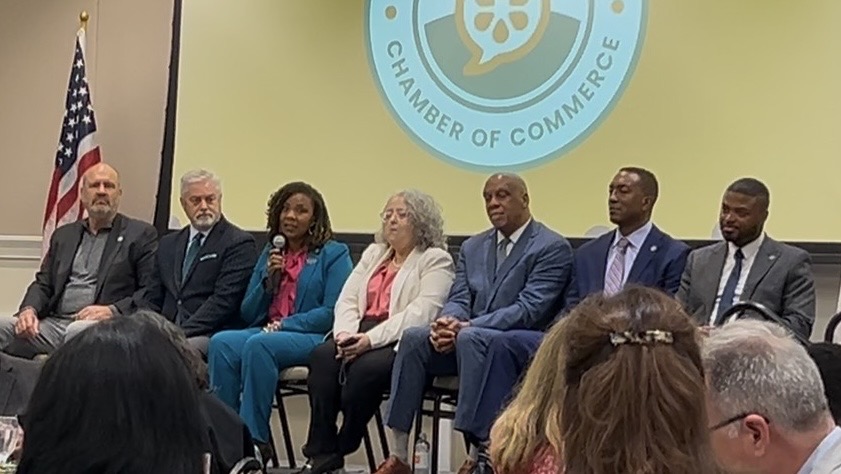
This is the second year in a row that the Florida Legislature ended its session without a budget and will require an April special session to complete. Hoover had asked the group whether the unfinished budget business signaled a “new normal.”
Bracy Davis said it should not be “business as usual.”
“I’m sure everybody in this room knows that the one Constitutional duty that the Legislature has is to pass the budget," she said. "So why … are we past our deadline and we have not done the one thing?”
Bracy Davis’ manner was congenial — she shared a laugh with Bankson after speaking, then squeezed his arm and shrugged in a way that seemed to say, I had to bring it up, you know?
Still, she did not shrink from chastising GOP legislators for “spend[ing] time on culture wars … on things that the working class are not asking us to spend time on,” then coming up short on the budget.
Indeed, Bankson sponsored many of the anti-drag show, anti-transgender and book-banning bills the House has considered in the last three years. For his part, Bankson attributed the delayed budget to the “after-effects of Covid” and the end of federal funding, saying, “I think that’s been part of the effect because we’ve got to get back to something that’s going to be consistent going forward, make sure we’re fiscally responsible there.”
Harris echoed Bracy Davis’ view that going into overtime to pass a budget “should not be the norm,” pointing out that special sessions are “very costly,” and “you want to be able to conduct that business within a 60-day window that we are supposed to be completing everything.”
She added that when lawmakers are called back for special sessions, “it costs money to make sure that we are reimbursed for housing, travel. It costs money to open up the capital and have people there working. So you want to … reserve it for things that are truly emergencies where you have to get the Legislature together in order to conduct business.”
Bracy Davis said in a Thursday text that she was “frustrated.”
“I spoke the reality. We wasted time. Time ran out. Now we have to go back,” she said. “People deserved the truth about why we have been delayed.”
But neither Truenow nor Antone saw the budget delay as particularly worrisome.
Antone described it as “one of those quirks.”
“It’s just one of those times that the House and the Senate can’t get together on the same page,” he said. “We'll go back in a couple weeks, and we'll get the budget ironed out. This is not the new norm. This happens sometimes. I think the first time I got elected, we had eight special sessions. So this time this is only one special session. So, it’s all good. It's all good. It's gonna all work out in the end.”
“We’ll get to the finish line with the budget,” assured Truenow. “I don’t see any real issues.”
When the panel discussion moved on to property taxes, Spencer told the crowd that while he would vote against it because “cutting property taxes is going to have a negative impact on our cities,” he believes voters “should have the final say.”
That perspective put him at odds with his fellow Democrats, like Harris who slammed any plans for a ballot measure to eliminate homestead property taxes as “irresponsible” and “extremely disingenuous.”
“Please understand that property taxes were on nobody’s radar until somebody who is clinging to relevance made it so,” she said. “Now the whole entire state is trying to figure out how cities and counties are gonna pay for services.”
Harris noted that there were vital discussions that could be had about reducing property taxes that would allow people to purchase new homes and stimulate the economy, but that the discussions happening now don’t address renters, where the funds to replace property taxes will come from to pay for community services or the continued high price of property insurance.
“I know when I pay property taxes, I’m getting services, but when I’m paying my monthly insurance for my home, I still worry that if I have an issue, I am going to have to go through the runaround to get my claim paid,” she said. “I would much rather ensure that my services stay intact and maybe lower my property insurance a little bit.”
Antone likened any property tax amendment to a Trojan Horse that “looks pretty, but once that thing opens up after dark, all hell is gonna break loose. And it’s gonna be costly.” He said he’d seen estimates of a $19 billion negative impact on the cities in Orange County and a $600 million impact on the county’s budget.
“We are playing with fire here,” he emphasized. “You put that thing on the ballot and if the messengers don’t come out and say This is bad, folks are gonna vote on it because they think it’s going to mean a lot of money. … This is really, really bad policy. And it’s irresponsible. This has nothing to do with partisan politics. This has everything to do with fiscal responsibility. This is bad policy.”
Bracy Davis pointed out that the Senate has taken up exactly none of the property tax bills. “Which speaks volumes by the way,” she said.
She said eliminating property taxes would also strip power away from local governments while not addressing what the property taxes pay for within various communities and where the funds to supplement those taxes would come from.
“I don’t know that the average tax-paying, educated, knowledgeable Floridian knows all the intricacies of the minutia of property taxes, so I think it’s concerning to say you’re going to get to save money and then we’re not really answering what happens with all of this money you saved. What is it going to affect in terms of the things you need to be a productive community? We haven’t seen it yet, but as for what I’m hearing on the House side of things, I’m not buying what they’re selling.”
Bankson, a member of the House Select Committee on Property Taxes, said there was a philosophical issue to tax reform, but admitted the “practical side is the challenge.” He said there was “no way” to equalize the effects of eliminating ad valorem taxes throughout the state because some municipalities are completely reliant on those monies to fund operations while others are less so.
“So it needs to be put out there,” he said. “Here's what it is, Here's how it will affect you, What do you choose? And based upon that, then we have to have the way to not just remove it, we've got to have a way to replace it. And if we can't do that, then it's pulling the rug out from under. I think these are good questions to ask, but we've got to do it not just from the philosophical level, but from the practical level as well.
“I think there’s an intentional looking at all of the aspects. But the Senate side hasn’t weighed in on that. It doesn’t matter what we pass in the House. If there’s not something in the Senate, it’s dead anyway.”


