"Local news worth reading" — The New York Times
SUBSCRIBE
The independent voice for West Orange County news
Correction: An earlier version of this story identified Sandra Fatmi-Hall as president of the Pine Hills Community Council. She is the first vice president.
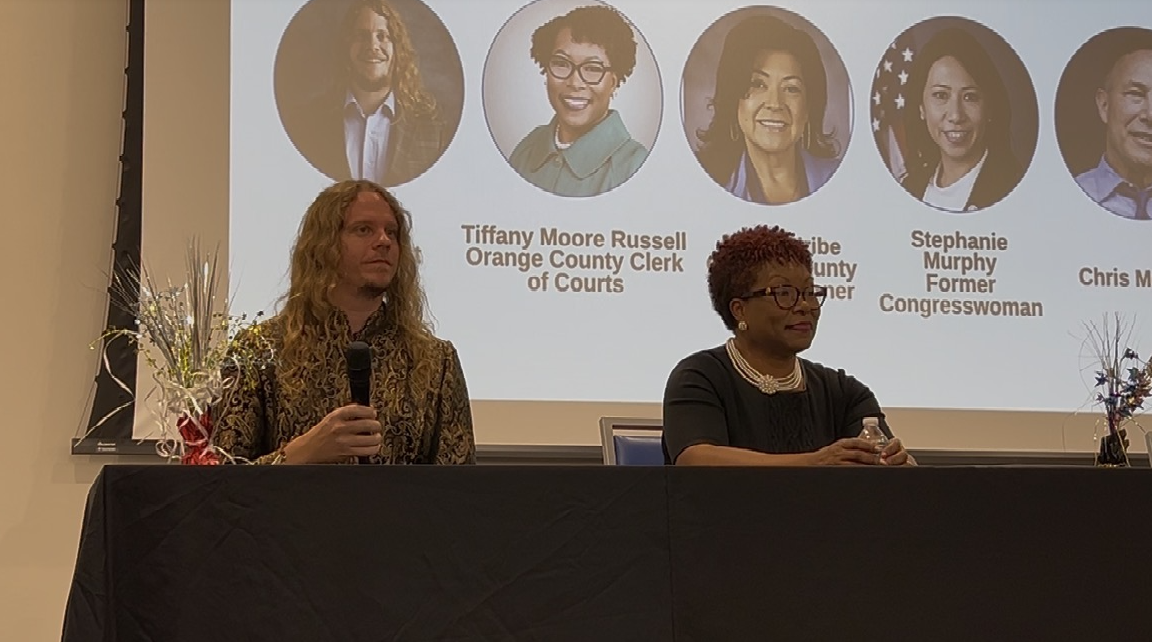
Affordability, transportation and jobs were cited as the top priorities for the five Orange County mayoral hopefuls who took the stage Tuesday evening at the Orange County Multicultural Center for a candidates forum hosted by the Pine Hills Community Council (PHCC).
The forum was part of PHCC’s May meeting, which also marked the council’s 50th anniversary and 54 years of serving the Pine Hills community.
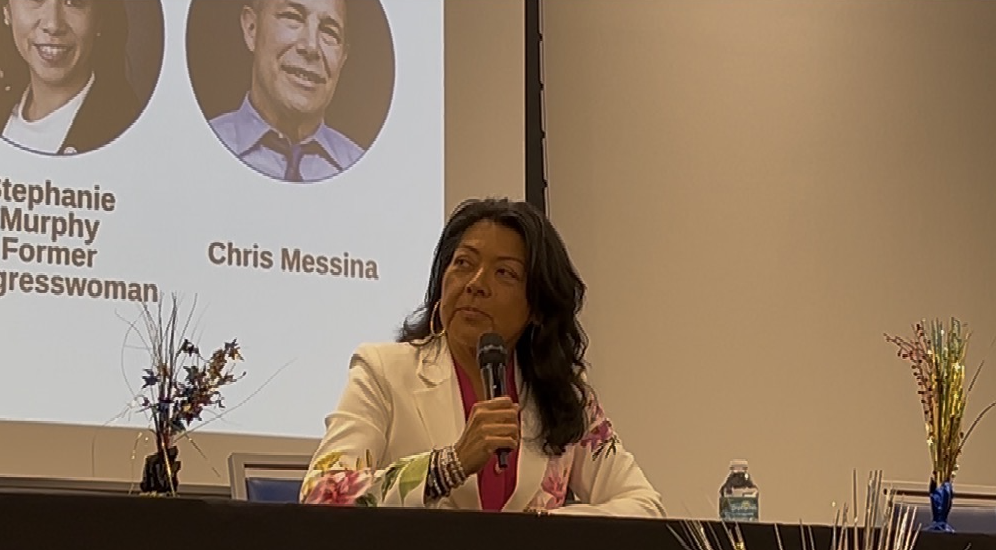
It featured Chris Messina, the lone Republican in the nonpartisan race, along with Democrats Randy Fust, an IT specialist; Orange County Clerk of Court and former District 6 County Commissioner Tiffany Moore Russell; Orange County Commissioner Mayra Uribe who represents District 3; and former Congresswoman Stephanie Murphy.
(Safraaz Alli and Brandy Griffin, also running for Orange County Mayor, did not attend.)
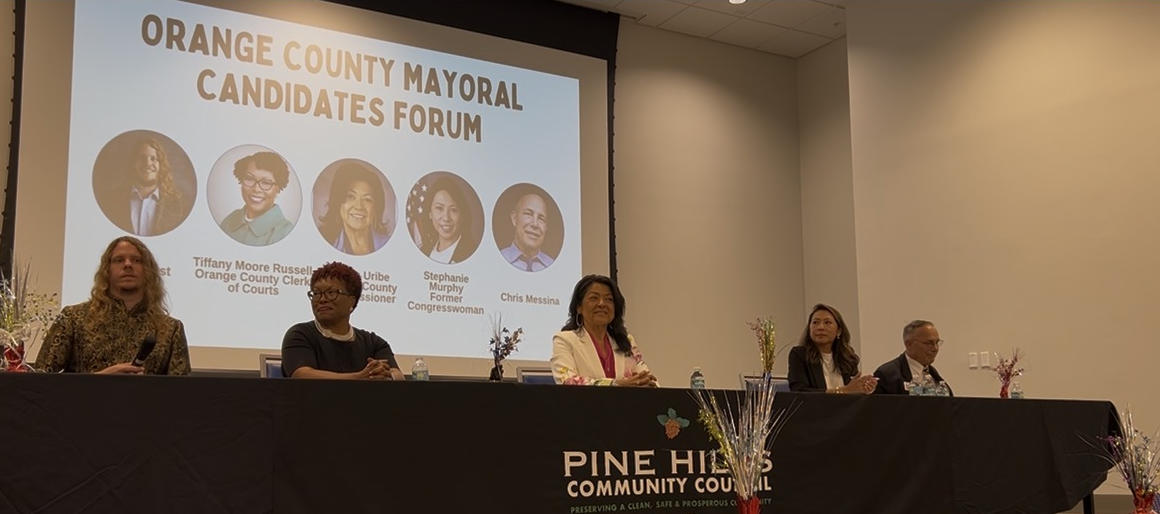
Moderated by Sandra Fatmi-Hall, PHCC first vice president, the 90-minute forum was the second mayoral candidates forum, after last month’s Democrats-only event, and the first to include Messina and Murphy.
The election to succeed Orange County Mayor Jerry L. Demings, who is term limited and now running for governor, is Aug. 18. The qualifying period runs June 8 through June 12. To earn a spot on the ballot, candidates must collect 8,369 verified signatures (representing 1 percent of the population) or pay a filing fee of $9,923.57
The only candidates currently working in Orange County government are Uribe, the three-term county commissioner and current frontrunner, who’s amassed more than $311,000 in contributions; and Russell, who has raised nearly $189,000.
Uribe said she was running “because it's time we put people first.” A first generation American whose father is Colombian and mother is from Argentina, Uribe said, “ When we look at housing, when we look at transportation, we get scraps, ladies and gentlemen, and I'm tired of the scraps.
“We need someone to fight for us, who's gonna not just look at housing, but stop generational poverty. Who's not just gonna look at transportation, but really, how do we make it work for us? And who's gonna prioritize good paying jobs for our children.”
Russell said the election was about affordability, citing Orange County families “who cannot afford to drive and pay gas to go from Winter Garden all the way downtown.” She emphasized her experience as a policy maker, former commissioner and head of a constitutional office who raised wages during her four terms in the clerk’s office from $12 to $17.
Former Rep. Stephanie Murphy, who represented District 7 from 2017 to 2022, said she was running because “we need strong county leadership with a vision for a future where every resident prospers.” She touted her humble beginnings growing up in a trailer park with parents who “ worked multiple jobs just to make ends meet” and her bona fides as a congresswoman and national security specialist for the Department of Defense.
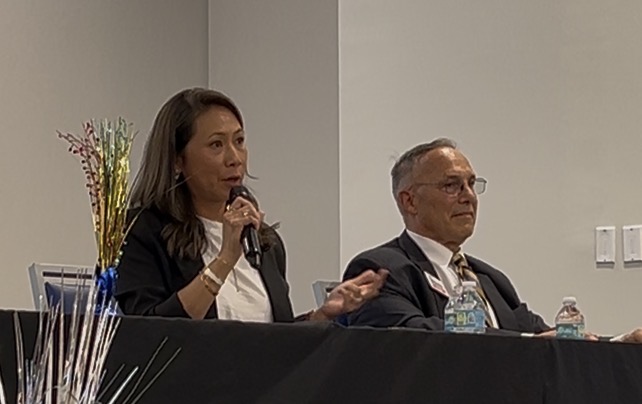
As mayor, Murphy, who’s raised nearly $290,000 in donations, said she would focus on “making our county more affordable, improving livability, and creating the kind of economic opportunity that lets families get ahead, not just simply get by."
Messina described himself as a Christian father of three, married to one woman for 25 years, who has “ spent three-plus decades in building high-tech businesses and trade associations … [that] have generated thousands of jobs and billions of dollars in revenue.” He told the audience, “We need to have great jobs. We need to keep our kids safe, and we need to reduce the overall cost of living. That's what I'm bringing to this campaign. That's what I'm bringing to this county.”
Fust said he was “just a regular guy with a regular service job in the tech industry, and I think that is a voice that is important to have in politics at all levels.” He noted that he got into politics by debating people on Tik-Tok. “I actually did convince a few extremely right wing Trump supporters that they should vote for Kamala Harris,” he said. “That’s my big claim to fame.”
Running a long-shot campaign, Fust who has raised just over $2,600 in contributions, said he was in the race to bring key issues to the attention of the public and other candidates, like promoting unions in the public and private sectors; protecting Split Oak Forest and opposing U.S. Immigration and Customs Enforcement (ICE) operations.
Candidates talked more about transportation issues than perhaps any other topic during the forum.
“Transportation is a public good,” said Murphy, adding that we should view it as a way to “connect people to opportunity” and make the investments in what will “move the greatest number of people to the greatest set of opportunities. This isn’t just physical mobility, but rather it’s economic mobility.”
Russell said that what’s needed is an “overall vision for a multi-modal system” along with a “dedicated funding source.”
“We have 13 unique cities in this county, and they all have different transportation needs,” she said. “So we need a countywide plan that's going to address how do we get Apopka to buy into this versus Horizons West." She added that while some roads need fixing, extending bus routes and bike routes is also essential.
Meanwhile, Messina favors tapping ride-share technology and downsizing buses so they’re more like Uber and Lyft. “The Lynx bus system is too oversized for a county as sprawling and spread out as Orange County,” he said. He would also consider tapping toll revenue for Brightline and SunRail.
A huge supporter of light rail, Fust envisions a hub and spoke light rail system “radiating outward from Orlando to all of our major population centers.”
All five candidates named access to affordable or attainable housing as a main priority. Fust said the “routes to that should be easy, not extremely difficult” although he did not provide any details for how that might be achieved.
Murphy said, “You have to increase the housing supply” to provide a range of options for first-time home-buyers, people looking for rentals and seniors while Messina said that ridding the county government of “waste, fraud and bureaucracy” would permit investment for affordable housing without raising taxes.
Uribe emphasized streamlining the county’s development process, saying that one reason housing is so expensive is because “it takes too long to develop.” She called Orange County’s process “broken.”
When it comes to jobs, all of the candidates talked about “diversifying the economy” to attract, as Uribe said, “real jobs that people can afford to live on.”
For Messina that means “high-tech jobs, particularly in space tech.” He said he was working to bring a Space Force academy to Orange County that “will spin off a billion dollars in revenues.” He also mentioned his initiative, Orange County Works, which “provides a partially subsidized trade school education for everybody who wants it.”
He suggested following the model of Osceola Prosper, which provides free community college or technical education for every high-school graduate in the county, something that Russell and Murphy also support.
“We should allocate $10 million to the program, which is what Osceola does with Osceola Prosper, but have it more focused on trade jobs,” Messina said. “There’s a shortage of 1,200 trade jobs in Orange County. Did you know a third-year plumber can make $100,000?”
Navigating productive relationships with people of opposing viewpoints and parties came up as an audience question — a key concern in our hyper-partisan environment — as did finding common ground with all of the commissioners, representing eight different districts.
Messina noted that he was vice chair of Orange County Watch, the bipartisan government accountability organization “where the chair is either a Democrat or Republican and the vice chair is the opposite.” He pointed to the sales tax increase as something the group worked together on to quash.
“ I thought it was destructive, it was regressive, and it was unnecessary, and so did a number of people from the other party … And we successfully stopped that. And I think that for people who are struggling with fixed costs, not having that extra sales tax really benefits people.”
Pointing out that she is “one of the few clerks that are Democrats” in Florida Court Clerks and Comptrollers, the association that represents all 67 county clerks of court in the state, Russell spoke of working across the aisle after Amendment 4 passed in 2018, restoring voting rights to formerly convicted felons who had served their time and paid their court debt.
“I had to work with some very conservative clerks that surround me to make sure they were also doing restoration of rights programs,” she said. “So I’ve had to work with Republican clerks to be able to address how do we provide access to justice for all citizens.”
Uribe emphasized that she worked closely with the municipal governments in her district, saying, “We’ve got to stop this Us Against Them. It's gotta be us together, because that's the only way we're gonna get transportation ahead. That's the only way we're gonna get housing ahead and infrastructure … And if property taxes roll back, we have to worry because cities may not be able to afford to maintain their status as cities because they're mostly reliant on residential taxes. So it's very important that the county work together.”
When it comes to working together as a board, Fust said, “There has to be room for compromise … That’s all we got. We either vote on the budge or we don’t and you can’t not vote on the budget, so we’re gonna get there.”
Russell said that learning what’s important to individual commissioners is essential and then filtering that through the mayor’s budget philosophy to provide services within the budget. “Every commissioner wants to have wins in their district,” she said.
Uribe said it comes down to negotiation to make sure that “everyone across Orange County gets equal services and equal representation.” She said that with the current commission, “we disagree a lot but we respect and love each other. We don’t bring politics into it. What we bring is heart and service and putting our community first.”
Murphy described it as “kind of horse trading … to get everybody a little bit of what they want in an effort to move the entire county toward a vision of greater prosperity for everybody.” She told the audience that at the Department of Defense, she set the budget priorities for the DoD’s $800 billion budget “when we had two ongoing wars in the Middle East. As you can imagine, a lot of people didn’t agree on where they fell out in the ranking stack of priorities. Often those people wore four stars,” she said, referring to the U.S. military’s highest ranking active duty officers.
Candidates were split on diversifying tourist development taxes (TDT, aka the 6 percent bed tax levied on temporary lodgings, like hotel rooms, vacation homes, Airbnb) beyond what the funds are already earmarked for by Tallahassee.
Messina said he was “absolutely” in favor of utilizing TDT funds for other innovative programs and pointed to a fire training center that he said could be developed into a destination for fire fighters from across the nation. He circled back to his Space Force academy as another destination that could benefit from TDT dollars.
Russell said she would not diversify TDT “as it exists today,” saying the money is already allocated to maintain the Orange County Convention Center, which provides jobs to residents. But, she added that she was open to increasing the tax by one or two pennies for additional services. “We still have one of the lowest taxes in the country when it comes to TDT,” she said.
Candidates were also divided on funding Visit Orlando.
While Russell fully supported renewing its contract, saying “if somebody’s not marketing us, we will not be marketing ourselves,” Uribe was opposed as was Fust. He argued that Orlando was a known quantity. “You can go to any other county and they’ll ask you where you’re from. You say Orlando and they know what you’re talking about,” he said.
Meanwhile, Uribe argued that Visit Orlando already gets too much money. “$120 million a year to promote all the big theme parks, and they don't take care of the small businesses,” she said, adding that the organization was not held accountable for the “wasted $20 million.”
“They need less money and we need to take care of our workers, and housing and first responders and transportation.” She said they had to “quit laying down and letting tourism get away with everything. We need to stand up and say No more.”