"Local news worth reading" — The New York Times
SUBSCRIBE
The independent voice for West Orange County news
As Matthew’s Hope Ministries prepares to roll out its fourth shelter bus next week — its first in West Orange County — a Christian homeless services organization on the Treasure Coast claims the ministry ripped off the mobile homeless shelter concept and design from them.
Based in Vero Beach, The Source filed its lawsuit in the Ninth Circuit Court in July 2025, accusing Matthew’s Hope and the Brevard Homeless Coalition of “misappropriating trade secrets and intellectual property,” causing reputational harm, lost sales and funding.
The lawsuit focuses on The Source’s Dignity Buses, described in the complaint as “the first of their kind, featuring 20 secure, climate-controlled individual sleep pods, each with security curtains, under-bus storage, pet pods, an onboard overnight security staff member, and monitored CCTV surveillance.”
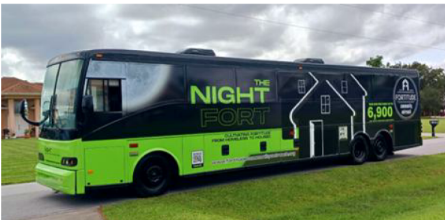
The Source Executive Director Anthony Zorbaugh claims that they were approached in 2024, first by Brevard Homeless Coalition and then Matthew’s Hope, to build buses for their organization. After Zorbaugh explained their design and construction process, provided photos and a tour, Matthew’s Hope used another manufacturer to build the buses on their own — then announced the mobile homeless shelters as their own concept to the news media.
In its lawsuit, The Source claims:
Although Plaintiff and Defendants profess to be serving the same goal of reducing the suffering of the homeless in the community, Plaintiff puts those words into action, lawfully, while the Defendants, acting with malice aforethought, served their own interests by taking intellectual property which belonged to neither, and then attempting to palm off the design and creation of the Dignity Buses to the public and governmental entities as their own. In doing so, Matthew's Hope has misled and confused the public … to profit from the sale of knock-off Dignity Buses and to capture the public acclaim from their promotion.
The Source (legally registered as I Am Ministries) is claiming at least $525,000 in damages. That’s roughly the cost to build the three buses Matthew’s Hope currently operates in Brevard County, according to the lawsuit.
After a mediation attempt failed in August, the court scheduled an Oct. 12 hearing on an emergency motion, filed by The Source, to prevent Matthew’s Hope from claiming ownership over the mobile homeless shelter concept and from bringing a bus to West Orange County. The judge declined to rule immediately on the West Orange County bus. The hearing was cancelled, and the lawsuit grinds on.

Matthew’s Hope Executive Director Scott Billue said that he was shocked when his organization, which has outposts in Winter Garden and Cocoa, was served with the lawsuit. “For one ministry to sue another ministry just, quite honestly, blows my mind,” he told VoxPopuli in a phone interview.
“I think it’s distasteful. I think it’s disgusting, abhorrent,” he said. “I can’t think of a word that would make it bad enough.”
What of the allegations that he copied the Dignity Bus design for his own sleeper buses? Billue said he was inspired by the same sources.
“I was always fascinated by sleeper cars on a train, like what Amtrak has,” Billue said. “That’s what the inside of my sleeper buses look like — inside of an Amtrak train.”
Ultimately, Billue, who is staring down a $468,000 funding shortage as people in need continue to stream into his organization, said that despite the risk that it may open them up to another $175,000 in damages, his organization is moving forward with its West Orange County bus.
“I think the lawsuit is frivolous," Billue said. “We have people that need to get off the streets.”
While nonprofits are no strangers to lawsuits, attorney Cliff Shepard, founding partner of the Maitland law firm Shepard, Smith, Hands & Brackins, who was not involved in this case, said this legal battle was out of the ordinary.
“It’s unusual to see one nonprofit for homeless people of all things suing another nonprofit for homeless people,” he said.
Zorbaugh did not respond to multiple requests for comment.
Since they converted their first commercial travel bus into a mobile homeless shelter in 2021, The Source has produced seven buses to date, selling them to other homeless service organizations, including the Christian Service Center in Orlando. A bus costs about $175,000.
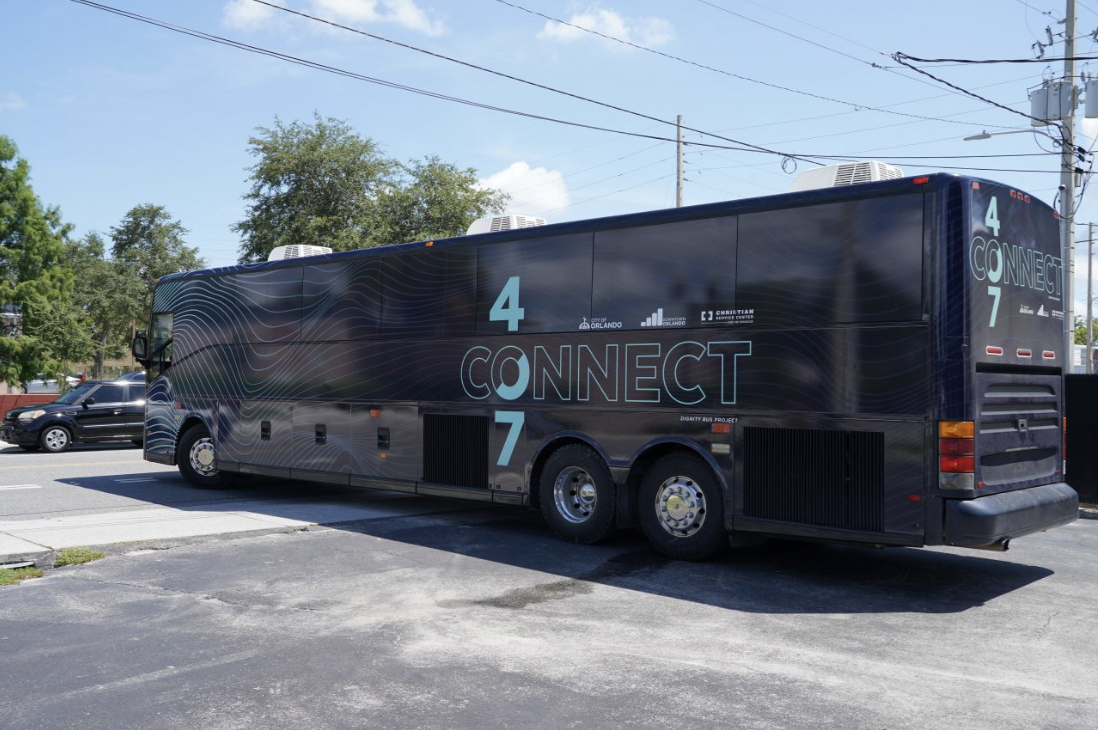
The crux of the lawsuit is The Source’s claim that it “developed a proprietary process and designs for converting standard travel buses into mobile homeless shelters …” and divulged that process in December 2024 during interactions, including a tour of the bus, to what was believed was a potential buyer.
The lawsuit states that Zorbaugh “detailed the components and considerations necessary, making BHC [Brevard Homeless Coalition] and Matthew's Hope privy to the design, look and feel, and refurbishing process to transform an old travel bus to a mobile homeless shelter …Without this information and access, learning how to transform a travel bus into a mobile homeless shelter akin to a Dignity Bus would have been practically impossible.”
Matthew’s Hope and Brevard Homeless Coalition's bus program was later announced in January 2025 as “spearheading a new idea,” as if the organizations had developed the concept themselves. Matthew’s Hope even photoshopped their logo and colors over the Dignity Bus design.
Billue told VoxPopuli he found a picture of a Dignity Bus online while searching for shelter bus photos and, under pressure for an event where Matthew’s Hope wanted to discuss its future plans for a shelter bus, he used the photo and superimposed the Matthew’s Hope logo onto it.
“It seemed easiest to me at that time to just take a picture [off the Internet] and put Matthew’s Hope on it,” he said, adding that he thought then that they were going to use The Source to build their buses before ultimately contracting with Tropical Coachworks. “The minute I was asked to take it down, we took it down.”
However, it appears that photos of the Dignity Bus may have been circulating around the Brevard Homeless Coalition since mid-2024. The lawsuit states that Brevard Homeless Coalition’s Sarah Slone requested photos of the Dignity Bus on July 15, 2024, when she was working on a presentation to secure funding for housing people who would be impacted by the anti public camping law. Zorbaugh said he sent the photos with the caveat that they only be used for informational purposes. It’s unclear if Billue would have had access to those photos, but certainly staff at Brevard Homeless Coalition did.

The Source is not the first organization to ever build a shelter bus, according to homelessness expert Andrew Sullivan, PhD, assistant professor in the School of Public Administration at University of Central Florida. But he hailed it as “a very innovative idea,” one that “hasn’t been tried in many places.” He noted that homeless shelters are often hard to get off the ground in communities because of zoning restrictions and community pushback from the Not In My Backyard or NIMBY crowd.
Residents and business owners often worry that a homeless shelter could increase foot traffic or crime while decreasing area property values, Sullivan said. While these concerns are not substantiated, shelter buses can (literally) get around them by moving between neighborhoods.
Meanwhile Orange County officials are grappling with the daily realities of too many people and too few affordable housing options. Florida lacks nearly 425,000 affordable homes, according to the National Low Income Housing Coalition while the Florida Housing Data Project found that Central Florida is short 100,000 affordable units homes.
In Orange County, the number of people experiencing homelessness rose 3 percent over last year, according to a 2026 survey by the Homeless Services Network of Central Florida. Between 2022 and 2026, the number of unsheltered people across Central Florida — meaning they were sleeping on the streets, in the woods, in cars or other places not intended for habitation — jumped 122 percent.
Orange County District 1 Commissioner Nicole Wilson said these statistics showed the “importance of having a creative approach” to getting more people into shelters. She praised the idea for the shelter bus and said there was a need for projects like this in Orange County.
“The shelter bus, the emergency shelter bus, is one of many tools that we’re trying to apply,” Wilson said, referring to the West Orange County shelter bus. She voted to provide Matthew’s Hope with a grant to bring a sleeper bus to a city in West Orange County, possibly Apopka.
“It’s really disappointing to hear that there’s some other entity out there that proclaims to be a service provider that is trying to prevent that mission from happening,” Wilson said.