"Local news worth reading" — The New York Times
SUBSCRIBE
The independent voice for West Orange County news
Seniors are facing homelessness. Working people are facing homelessness. Families are facing homelessness.
As we enter year two of Florida’s ban on sleeping and “unauthorized” camping on public sidewalks and in parks, the continued rise in homelessness was the takeaway of the “tell the truth about homelessness” press conference, organized earlier this month by District 5 County Commissioner Dr. Kelly Martinez Semrad together with advocates and providers of services to the homeless community.
The event, held at the Orange County Administration Building, was sparsely attended, but that didn’t make the message any less urgent.
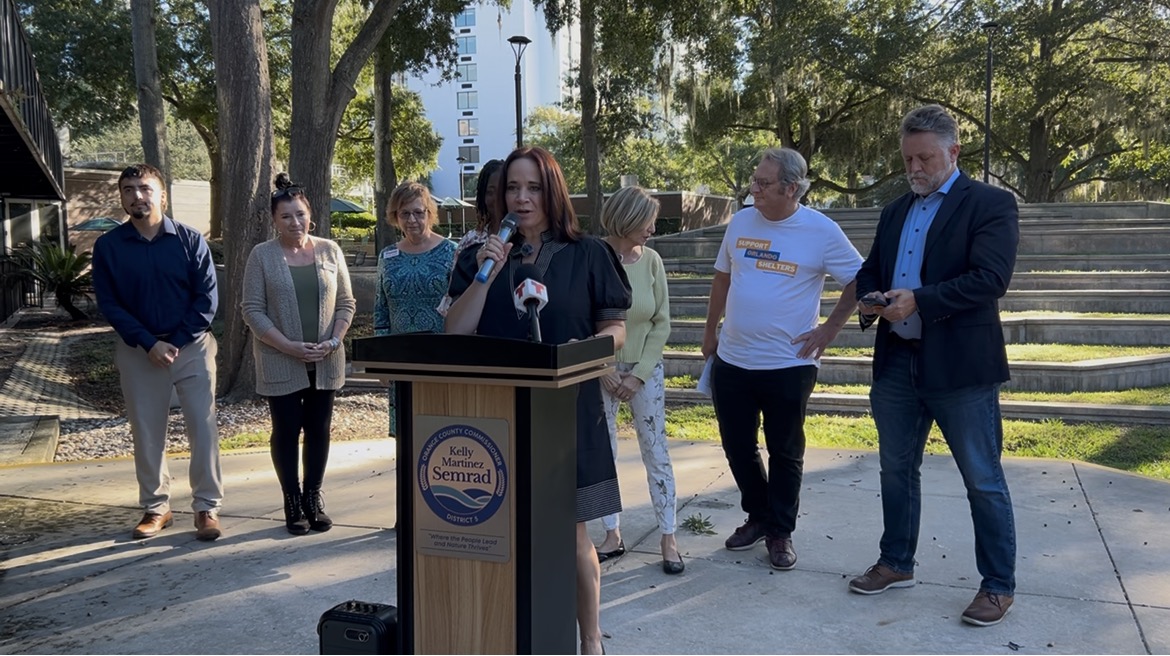
“ For every one family that's getting housed, there are a hundred that are not," Semrad said. "The effort to try to get people into housing is becoming more and more difficult to achieve. We all know this because we see our unhoused neighbors in the streets. We see them under bridges. We see them in the woods. We see them living behind dumpsters. We know that the problem is getting worse week after week, month after month in Orange County.”
And that doesn't even take into consideration a whole other sub-category of homelessness that flies under the social services radar: people who couch surf between friends’ homes, crash with family members, bounce between budget motels or sleep in their cars.
“In Orange County, nearly 2,000 people were counted experiencing homelessness on a single night this year, and that's just the people that we could find,” said Eric Gray, president of Christian Service Center for the Homeless in downtown Orlando. “None of them were people living in cars, which we think doubles that number.”
Here are four more takeaways from the event:
Gray emphasized that homelessness is not a personal failing — it's an "access to affordable housing" problem. Addiction and mental illness can make one vulnerable to homelessness, he said, but “those challenges exist in every community across America. Pretty equally actually."
Gray, who said his goal is to end homelessness, not make it more comfortable, explained, “What separates different communities with high rates of homelessness from those with lower is overwhelmingly the cost and availability of housing."
Semrad noted that the region is short nearly 100,000 homes “between zero to 80 percent area median income (AMI) for low-income households.”
[AMI is the midpoint income for households in a specific area — half earn more, half earn less. The number is used to determine eligibility for housing assistance.]
Some families have seen their rents jump $400, $700 even $1,000 more a month, according to Diana Jeremiah, director of operations at the Samaritan Resource Center in Orlando.
“Even if they can redo their budget and take their food budget and say, I'll now apply that towards my rent, so this year I can stay housed with my family, they are being turned away with, You don't make three times the new rent. You have to leave. We're seeing more and more families on the street.”
Semrad noted that many affordable housing units in the area are already occupied by people with higher incomes who are still having trouble finding housing. “If you are making about $54,000 a year, $25 an hour, you are struggling to find housing in Orange County you can afford," she said.
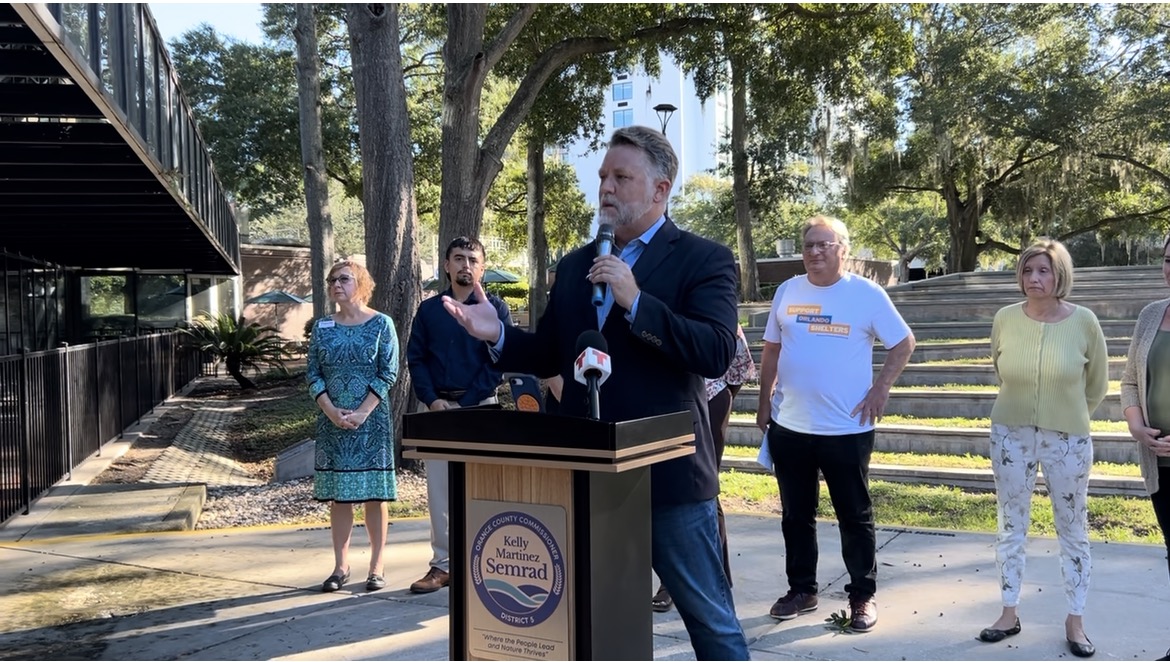
Cindy Taylor, senior director of day services for Pathlight Home, said her organization sees many seniors facing homelessness because they’ve lost a spouse, had medical issues or they can’t come up with three times the rent for housing. [Landlords and leasing companies typically require a before-tax income of three times the monthly rent. On an average apartment rental of $1,300, that would come to $3,900.]
“When you have an individual that's receiving $987 a month, it's hard to place them in housing,” Taylor said.
People 55 and older on fixed incomes are the fastest growing segment of the homeless community — up 6 percent over 2025, according to this year’s annual Point In Time Count (PIT), which surveys people who are homeless on a specific night in January.
“Singles on Social Security that we all took for granted we were going to be able to retire on, but because of what is going on in Florida, they can't afford to live on their own anymore, and they're finding themselves on the street,” said Jeremiah.
“We cannot solve homelessness simply by helping people leave the streets if our housing market continues pushing more people into the streets,” Gray said.
He said he worries about the federal government’s move away from the strategy known as “housing first.”
“Housing first does not mean housing only,” Gray said. “We absolutely need treatment, we absolutely need accountability, and we absolutely need supportive services. But those things are not alternatives to housing. They all work better together, and taking resources away from permanent housing will not make homelessness disappear. It risks making the problem worse.
“The measure of our success should not be how many meals we serve or how many shelter beds we fill, or even how many people we help on any particular day,” he said. “The ultimate measure is how many of our neighbors no longer need those services because they have a safe, stable place to call home.”
If passed, Amendment 3, would make this “bad situation worse,” said former Rep. Anna V. Eskamani, now running for Orlando mayor.
The ballot measure, which needs 60 percent voter approval to pass, would increase the homestead exemption on primary residences for homeowners from $50,000 to $150,000 in 2027 and to $250,000 in 2028.
Research suggests that both pricing for home sales and rentals could increase as a result of the ballot measure passing while the pool of available housing could shrink. Property tax expert Jared Walczak, of Walczak Policy Consulting in Washington, D.C., wrote in a recent analysis that as landlord profits diminish, it may become “less attractive to build new apartments and other rental housing, further constricting housing availability and making the remaining stock less affordable.”
Walczak added that the climate could chill construction of new income-restricted units and new construction in general since developers wouldn’t know which cities would be raising property taxes or fees or cutting services that could be important to their projects.