"Local news worth reading" — The New York Times
SUBSCRIBE
The independent voice for West Orange County news
Is tax-payer money being spent wisely?
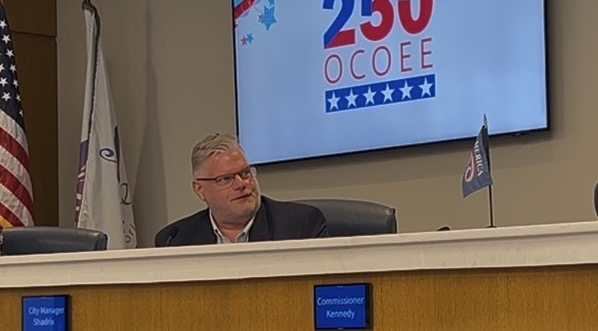
That’s what was on the minds of two Ocoee residents who spoke up Wednesday, Sept. 9, during the public comment period of Ocoee’s first budget hearing.
Following City Finance Director Steve Weber’s quick-walk through highlights of the city’s proposed 2026-2027 $140.6 million budget, which had been discussed in detail during the Aug. 6 budget workshop, Ocoee resident Johnmichael Fernandez told the commission there were “some budget line items [he] wanted to mention.
Fernandez then rattled off a string of items totaling nearly $2 million that he said “either need to be cut from the budget, re-addressed, re-looked at or at least given a better explanation to the citizens of why that’s in the budget.”
The things Fernandez flagged were:
Special projects, mayor’s fund: $58,500
Travel fund: $32,500
Community promotion: $48,600
Professional dues: $25,000
Neighborhood grants: $28,000
SUBTOTAL: $192,600
Lobbyists: $71,250
Professional dues: $16,500
Community promotion: $17,000
Training: $9,000
SUBTOTAL: $113,000
Advisory boards: $13,000
SUBTOTAL: $13,000
Salary study: $30,000
Travel: $4,000
Employee gifts: $56,000
Hiring incentive: $25,000
Education reimbursement: $35,000
SUBTOTAL: $150,000
Travel: $10,000
Professional dues: $7,000
Community promotions: $2,000
Software: $30,000
SUBTOTAL: $49,000
Red light cameras: $550,000
Flock cameras: $12,000
Cubicles: $45,000
Community promotions: $35,000
SUBTOTAL: $642,000
Travel: $7,500
Advisory board: $2,000
Community promotion: $2,000
SUBTOTAL: $11,500
Travel: $7,500
Professional dues: $20,355
Community promotions: $22,000
SUBTOTAL: $49,885
Holiday Decorations for City Hall: $80,000
Marketing: $12,000
Wedding venue map: $4,000
Miscellaneous: $5,000
Advisory board: $4,000
Training: $5,000
City events: $215,000
Community promotions: $114,100
SUBTOTAL: $439,000
Travel: $5,200
Professional dues: $2,000
Holiday lights: $400,000
SUBTOTAL: $407,200
TOTAL: $1,954,185
Doug Gomber, who represents Ocoee on Orange County’s Tourist Development Tax Citizen Advisory Task Force, weighed in following Fernandez’s comments.
“All those things that you’re talking about,” Gomber said, addressing Fernandez’s comments, “are all parts of running any business, any city, any commission, any county. Those are all things that come to make the community better.”
Gomber said that as he looked at the department budgets, for the most part, “I don’t see any fat.” He noted that despite escalating costs, “we all benefit from the community being as strong and as friendly as it can be. Our property values, all of us, are tied to the fact that this community is strong. It’s safe. And it’s got plenty of public works. This is a desirable community to live in. There are a lot of communities that don’t have what we have here.” He added that the city has maintained its millage rate for nine years.
“We could cut this thing to the bare bones and be a skeleton, but nobody’s gonna wanna live here, and your property values are gonna drop,” Gomber warned.
Commissioners defended many of the items Fernandez listed.
“It sounds massive when you really just kind of read it out and just listen to it without an understanding of what really happens on the back end and what would it mean to cut a lot — even if you just cut them in half — and what would that mean for the services that we provide here in our city for our citizens,” said District 4 Commissioner George Oliver III.
District 2 Commissioner Rosemary Wilsen explained one reason the city employs lobbyists: a unified zip code, which is one of her pet issues. The city has worked for years to unite all of Ocoee under a single zip code rather than the seven it currently has. Wilsen noted that the cost differentials on insurance for homes a mile apart but in different zip codes can be as much as $1,000. Last year, a bill to create single zip codes for 14 cities, including Ocoee, passed the U.S. House Of Representatives, but stalled in the Senate. Lobbyists help shepherd legislation like that along.
Wilsen also noted that she taps her $10,000 discretionary fund for items like installing an automated external defibrillator stand in Tiger Minor Park. She added that she doesn’t travel much but when she does, it’s to the Florida League of Cities and National League of Cities “where we’re learning and coming back with information to enrich ourselves as your representative.”
Mayor Rusty Johnson said he uses his funds to help defray travel expenses for students to attend sports competitions and other activities.
“We all pay school taxes, but the school board does not give part of that stuff back to the kids. These children are out going to functions through the school that their parents are having to pay money again,” said Johnson. “They want them to be at the ball games, they want them to do this stuff but they don’t give them the money for it. So the little things, the discretionary funds help people out with.”
“I don’t think we’re doing anything that is frills to us,” said Wilsen. “I believe this is all 100 percent needed.”
Wilsen also spoke about the city’s Christmas lights. Both the Public Works and Parks and Recreation departments have holiday decoration budgets totaling a combined $480,000 in 2026-2027. She said while it may seem like “frill,” the decor adds to the community and helps bring residents out to events and to local businesses.
“It makes the community what the community is,” she said.
Wilsen admitted that one year she didn’t want to fund the Christmas lights. “Oh boy! I will never do that again!” she said, adding that she was nicknamed Bah Humbug that year as a result. “I shouldn’t say what was raised by the community. They were furious that we didn’t have Christmas lights.”
VoxPopuli has reached out to the city for explanations about Human Resources' $30,000 salary study; $56,000 employee gifts; $35,000 education reimbursement; and Parks and Recreations' separate $80,000 holiday decorations budget, and $5,000 in miscellaneous funds.