"Local news worth reading" — The New York Times
SUBSCRIBE
The independent voice for West Orange County news
Ocoee is holding its millage rate at 4.95 mills, according to Finance Director Steve Weber, who presented the city’s tentative budget Wednesday during the city’s budget workshop.
The city has maintained 4.95 mills for the last five years, the lowest level it’s been for the last decade, according to the budget posted online. Weber also noted that the city’s gross taxable value increased 7.8 percent over last year from $5.4 billion to $5.9 billion.
The budget workshop lasted an hour, and the commission decided no further workshops were required.
The first budget hearing will take place Sept. 9 with a second hearing to adopt the budget on Sept. 23. The new 2026-2027 fiscal year begins Oct. 1.
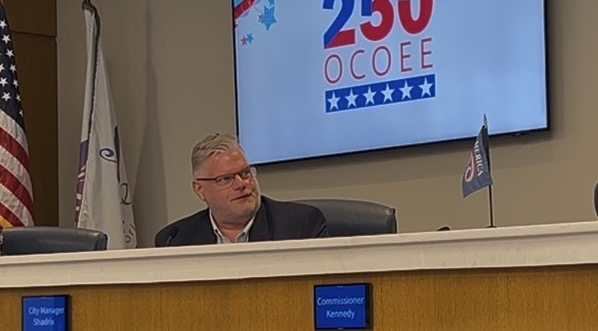
District 2 Commissioner Rosemary Wilsen emphasized that the Ocoee budget referred to a single line only on residents’ trim notice — not the total, which will include county fees, library fees and St. Johns Water Management fees, among others.
“When we talk about the budget, we're only talking about the Ocoee line in there,” she said.
The linchpin of Ocoee’s budget is the outcome of an Aug. 18 vote to enable the city to raise the fire assessment to a maximum of 70 percent of the fire department’s assessable budget if necessary without returning to the commission again for approval and then to set the 2026-2027 rate at 45 percent.
The flat-rate 45 percent fee, levied on every Ocoee property, will help offset the revenue loss the city expects next year if Amendment 3 (property tax reform) passes in November.
“ I hate being the guy that has to raise a fee around here, but it's an obligation to start shifting the reliance away from property taxes,” said City Manager Craig Shadrix, who described the city’s fire fee strategy as “very proactive on Amendment 3.”
The city anticipates collecting $37,047,485 in total tax revenue with $27,554,139 in property taxes — about 37 percent of the General Fund’s $$74.3 million budget. The General Fund pays for the majority of city services.
If Amendment 3 passes, the city expects to lose $4 million in property tax revenue in 2027 as the homestead property exemption increases to $150,000. In 2028; as the exemption jumps to $250,000, the city foresees losing $8 million in revenue.
If Amendment 3 does not pass, Shadrix said he would recommend the city reset the fire fee at its current 36 percent and “refund the additional 9 percent back to the citizens and property owners.”
The city’s total budget is $140.6 million, encompassing the General Fund, Utilities Fund, Stormwater Fund, Solid Waste Fund, Impact Fees Funds and other operating funds.
Two additional enterprise funds — Ocoee calls them “Business-Like Funds” — were created for fiscal 2026-2027: Building Fund and Emergency Medical Services Fund. This allowed $5.9 million in expenditures to be moved out of the General Fund and into their respective enterprise funds. Sixteen staff positions in the Building Department and 12 new paramedics are now also classified under their enterprise funds. This provides better financial tracking and more transparency, according to Assistant City Manager Mike Rumer.
Using a zero-based budgeting strategy, in which each department justified its budget requests, the city trimmed $10 million from its 2027 operating budgets compared with last year and cut the General Fund budget by nearly $3 million, from $77.2 million in 2026 to $74.3 million.
Even as the budget reflects a nearly 4 percent reduction in expenditures over last year, the city budgeted $2.2 million for roadway resurfacing, $600,000 for repairing and replacing sidewalks and found $40,000 for a new columbarium for the cemetery, $1.2 million for improvements to Lake Apopka Waterside Park; and $20,000 for sound reduction panels for pickle ball courts.
The community events budget, however, has been slashed by 61.25 percent over last year, from $400,000 to $155,000.
According to the city, nearly 91 percent of Ocoee residents who responded to a recent community survey ranked fire and emergency service as the “most important city service” with police a close second at 89.6 percent.
Unsurprisingly, public safety continues to be the city’s biggest expense, accounting for 55 percent ($40.6 million) of the General Fund. The majority of that is the police department with a $25.5 million budget; the fire department has a $14.5 million budget. Funds have been earmarked for radios, police vehicles, an ambulance.
The public safety personnel budget jumped 8.34 percent to $33 million for 2027, a $2.5 million increase over 2026, according to the tentative budget report, reflecting a need to remain competitive with Orange County and Orlando agencies.
Non-union city employees also received a 4.5 percent cost of living increase, adding $48.4 million to the city’s bottom line, a 5.5 percent increase over last year.
Between 2025 and 2026, city commission expenses jumped from $160,306 to $474,907 — a 74 percent increase, according to the budget report. For 2027, budgeted expenses are increasing nearly $16,000.
Health insurance, first put in place in 2026 and and again 2027, accounts for about $200,000 in expenses each year.
However, there is also $58,500 of discretionary funds budgeted for “special projects” — $10,000 per commissioner, with an additional Mayor/Commissioner Fund of $8,500. There's another $32,500, split among the commissioners, allotted for travel. That's a total of $91,000 in discretionary funds for the commission.
Community promotion, also in the city commission budget bucket, has increased as well, from $11,000 in 2025 to $18,000 in 2026 to $48,000, budgeted for 2027. Expected outlays include $20,000 to the Boys & Girls Club; $4,500 to the Tri-County Luncheon; $4,000 to Best Fest; $1,000 to the Big Orange Awards; and $500 to Celebrating Extraordinary Women, along with $14,000 in "miscellaneous" funding.