"Local news worth reading" — The New York Times
SUBSCRIBE
The independent voice for West Orange County news
Despite pleas from frustrated residents that the fire protection fee is too costly and unfair, the Ocoee City Commission unanimously approved a new higher rate Tuesday night, shifting more of the department’s costs to property owners.
More than two dozen residents decried the fee increase during an 80-minute public hearing, many saying they are longtime residents on fixed incomes already struggling with rising living costs. While praising the Ocoee Fire Department and its firefighters, they said the higher fee would be unsustainable. Some warned commissioners that voting for the new rate could cost them their seats in future elections.
Under the new plan, all single-family homes, regardless of size, will pay an annual flat rate of $383.90 for fiscal year 2027, which begins Oct. 1. The new rate is about 59 percent higher than the city’s previous average residential assessment of $242, officials said. The assessment for multifamily, commercial, industrial and other nonresidential facilities is based on square footage.

Commissioners voted 4-0 to approve the new rate. District 4 Commissioner George Oliver III was absent. (The city commission meeting coincided with Florida’s Primary Election, and Oliver was a candidate for District 2 County Commissioner. He lost.)
The fire fee is expected to generate $4.5 million annually, roughly 30 percent of the Ocoee Fire Department’s $14.8 million budget. Officials said the rate increase is needed to maintain current service levels and offset rising costs for equipment, gear and training. Personnel costs make up about 75 percent of the department’s budget.
“Our costs are going up, way higher than inflation,” said City Manager Craig Shadrix in response to residents’ comments during the hearing. He cited the rising cost of fire engines as one example, saying an engine that cost about $580,000 more than a decade ago now costs more than $1.7 million. The city will need to replace older trucks in the coming years, he said.
Increasing the fire fee to $383.90 is also intended to help offset the $4 million revenue loss the city anticipates next year if Amendment 3’s property tax reform passes in November. If the amendment passes, the city may again raise the fee to $597.16 in 2028 to buffer the expected loss of $8 million in property tax revenue. However, Shadrix said during the city’s Aug. 5 budget workshop that if the amendment doesn’t pass, he will request that the commission reset the fire fee to current levels.
Residents, some visibly emotional and upset, packed the commission’s chambers. The crowd was so large, an overflow room was set up for residents to watch the proceedings. Many who spoke during public comment echoed the same worries: living on Social Security or other fixed incomes, dealing with disabilities or costly medical treatment, or questioning why the city’s formula charged the same availability rate regardless of a single-family home's size.
Ocoee divides the fire assessment into two parts: a demand charge, based on the number of residential dwelling units or the size of nonresidential buildings, and an availability charge for keeping fire protection services available to the property.
Under the availability formula, the city uses 2,423 square feet as the benchmark for one “equivalent dwelling unit,” or EDU. Each single-family dwelling is assigned one EDU regardless of its actual size. In other words, a 1,200-square-foot house and a 4,000-square-foot house are both one EDU and pay the same availability charge.
That didn’t sit well with Romeo Paquette, a 43-year Ocoee resident who said during public comment that it’s unfair for owners of smaller homes to pay the same amount as owners of substantially larger homes. He said the increase would place a financial burden on residents of smaller homes who could least afford it and called for a “major adjustment” to the formula.
Resident Barbara Blair said no houses in her neighborhood are more than 2,400 square feet, except one. She said it isn’t fair for her to pay the same availability charge as someone who lives in a 3,000- or 5,000-square-foot house.
“It's just like if I go buy a Corvette, you go buy a Lamborghini. Is it fair for you to pay what I pay for my Corvette? No, it's not fair … Y’all need to redo this.”
Later in the meeting, Shadrix said the fire department sends the same resources to a residential fire regardless of the size of the house.
A visibly emotional Vicenza Curry, a 30-year city resident, said she’s on Social Security disability. “I cannot afford this tax,” she said, adding that she may have to sell her house and move. “I don't want to do that. I'd like to stay here.”
Another longtime resident, Glenda Jackson, said she lives with her 78-year-old husband on a “very limited income.”
She said three years ago she was diagnosed with an “incurable” cancer.
“I have to apply for a grant to pay for my medicine, so I can’t afford this. And I just want to know what you’re going to do to try to help the little people,” she said. “I’m beyond myself.”
Landlords Bobby and Betty Haas said they may have to pass the increased cost on to their tenants. Betty said she broke the news to one tenant before Tuesday's hearing.
“And when she heard what was going to happen, her face just went, $50 a month more? I'm like, I have no choice. I can't continue paying all these fees and things out of our pockets.”
Betty asked the commission to rescind the assessment, make the appropriate changes to the millage rate and root out waste in the city budget for more savings.
Bobby was concerned that if they were forced to raise the rent, four of their tenants on disability could end up homeless.
“So it looks like that's what we're going to do for the sake of more money is put more people like that on the street. I don't get it,” he said.
Gary Boyer, president and founder of the Boyer Building Corporation, said his assessment on his commercial property would rise to nearly $8,000 next year, an increase he calculated at about 550 percent from the previous year. Under Ocoee's formula, commercial properties are charged based on both building square footage and equivalent dwelling units.
“This level of increase is disproportionate and legally indefensible for a non-ad valorem assessment,” he said. “Under Florida law, non-ad valorem assessments cannot function as a disguised tax and must be reasonably apportioned based on service demand.”
Boyer said his company has invested $170,000 in a fully monitored fire suppression sprinkler and alarm system with annual inspections and testing to remain in compliance. He said the city is imposing a fire fee without recognizing such investments. It “effectively forces building owners to pay twice for fire protection while fully absorbing the burden of site safety on our own balance sheets,” he added.
He urged the commission to create a “fee credit or adjustment mechanism” for commercial properties that invest in and maintain such fire suppression and alarm systems.
Throughout the hearing, several residents referred to $597.16 as the amount the city would charge per EDU in 2028. City officials said that figure was instead the maximum proposed residential assessment under a five-year plan designed to allow the fire assessment to fund up to 70 percent of the fire department's assessable budget.
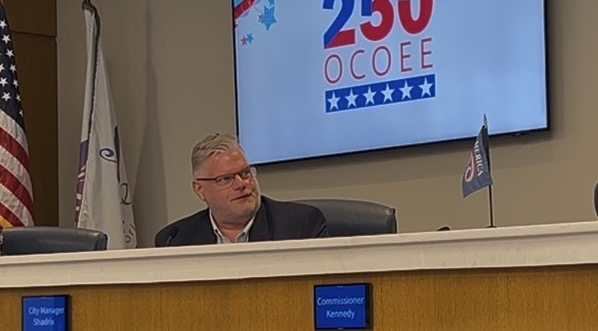
District 1 Commissioner Scott Kennedy described the $597.16 charge as a “cap,” not necessarily the amount homeowners would pay in future years. City officials have previously said the five-year plan considers a new union contract and the potential passage of Amendment 3 in November, which would raise the tax exemption for homesteaded properties to $150,000 in 2027 and $250,000 in 2028. The five-year plan also gives the city flexibility to adjust future assessments without undergoing a new rate-adoption process every year, officials have said.
In response to residents who said the city should cut spending before raising the assessment, Kennedy said officials have reduced costs, lowered the millage rate and required departments to justify spending through zero-based budgeting.
Kennedy also said he agreed with Gary Boyer and would recommend a separate nonresidential category for companies to pay a different rate if they have fire suppression sprinkler and alarm systems.
District 2 Commissioner Rosemary Wilsen said she’s a retiree on Social Security, identifying with several residents who said they’re on fixed incomes.
“We are no different than probably most of you,” she said. “We're not the bad guys. We're just up here trying to do the best we can for you.”
Wilsen argued that Ocoee residents receive more municipal services for the taxes and fees they pay than they would receive from the county alone. She added the $383.90 fire fee “is not too much to ask to have the service that we have been accustomed to.”
District 3 Commissioner Richard Firstner, a former Ocoee fire chief himself, pointed to the Ocoee Fire Department's national accreditation, saying it is one of 308 accredited such departments among roughly 27,000 nationwide.
“So, I don't know if it's any consolation to you, but you can rest assured that your tax dollars are paying for the best fire, police and EMS service that money can buy,” he said.