"Local news worth reading" — The New York Times
SUBSCRIBE
The independent voice for West Orange County news
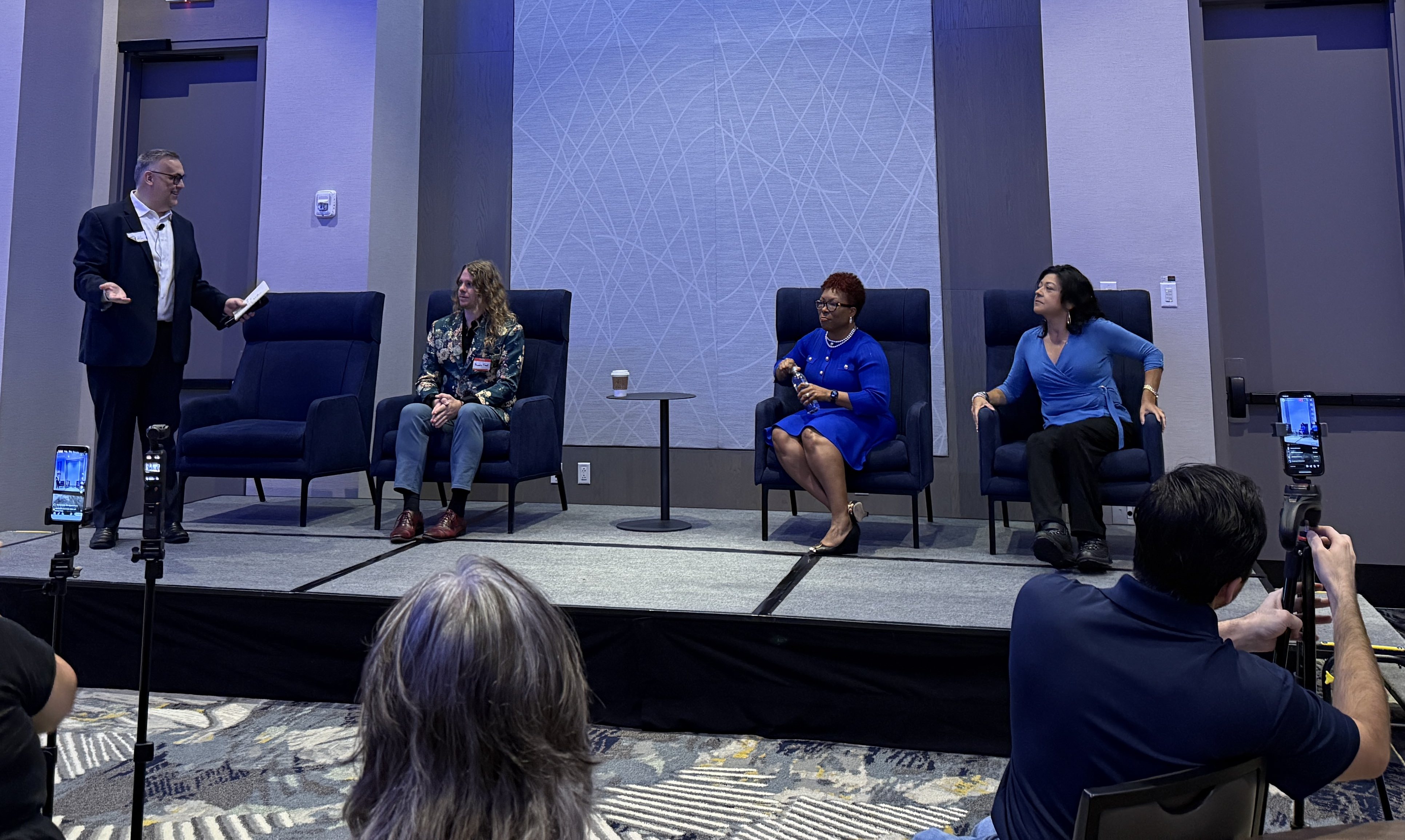
Lake Nona Democrats on Saturday hosted the first forum for Democratic candidates running in the Aug. 18 election to be Orange County’s next mayor.
Three of the now seven Democratic candidates in the race participated: Orange County Clerk of Court Tiffany Moore Russell; Orange County District 3 Commissioner Mayra Uribe; and IT specialist Randy Fust, Jr.
Held at the Aloft Hotel in Lake Nona, the event drew 130 attendees eager to get at least a partial look at the mayoral field. While the election qualifying period is not until June 8-12, Paul Snatchko, vice president of the Lake Nona Democrats and the forum moderator, said they organized the event so that voters would start thinking about the race earlier.
Safraaz Alli, 46, who was scheduled to participate, had been suddenly called out of town for a family emergency, Snatchko said. He added that Brandy Griffin — until recently Alli’s treasurer — filed to run for mayor on April 3, which was too late to be included in the morning’s program. Chris Messina, 67, was not included in this forum because he is running as a Republican.
More noticeably absent was former Democratic Congresswoman Stephanie Murphy. Snatchko told VoxPopuli that Murphy had agreed to participate in the event, but pulled out about 10 days ago with the explanation that she would only participate in events once all candidates were qualified. The qualifying period is June 8-12.
VoxPopuli reached out to the Murphy campaign for comment, but received no response.
During the forum, which ran just over an hour, candidates answered questions on housing, transportation, tourist development and property taxes, Immigration and Customs Enforcement (ICE) and the Pulse Memorial. You can watch the forum on VoxPopuli’s YouTube channel. Here are some of the high points:
Fust, 32, who describes himself as a “shield against government overreach” on his candidate Facebook page, told the crowd, that he was “running on giving our employees a louder voice in discussions with their employers … on protecting our undeveloped lands … and an unwavering commitment to preserve civil rights for every single member of this community.”
He candidly said that he couldn’t provide all of the answers because he hasn’t “managed billion dollar budgets and [hasn’t] felt the weight of a community of my shoulders.” But he added that he thought there would be problems that “traditional politics is going to struggle to greatly to solve that are coming down from both the federal and state governments” so it would be necessary to have “local leaders who can see beyond the veil of traditional politics.”
Moore Russell, 50, who served two terms as Orange County District 6 Commissioner, is focused on affordability. “I'm running on what does it cost for our community to live here, play here, and work here,” she said. “We know that there are transportation issues, public safety issues, all impacting the overall quality of life for the residents of Orange County.”
Uribe, 52, a three-term county commissioner and a first-generation American whose parents come from Colombia and Argentina, told the crowd she and her husband still live in the Pine Castle community she was born and raised in. “I’m not abandoning my community. Because what do we do when we want to see better? We stay there, and we fight for the people who are losing their voices. This is the epitome of what public service has been for all of us.” Uribe said she’s running “because I’m worried about our future. We know what’s going on at the federal and local level. But, ladies and gentlemen, it all starts here. It all starts local.”
Moore Russell said she would bring in consultants to streamline county operations and improve efficiency. Fust said he would focus on updating the county’s technology and look for unused or underutilized properties to develop low-barrier housing.
Noting that it shouldn’t be so time-consuming to get permits for one’s own property or so costly to run a small business, Uribe sounded like she was planning some departmental changes.
“ I have been looking at this organizational chart for seven years, and I can tell you we have problems in project engineering, public works; we have problems in solid waste, we have problems in permitting, planning and zoning,” she said. “I already know who I want to be the next county administrator, deputy county administrator, and I kind of look at the future of Orange County as Are you part of the problem or are you part of the solution? Because we have a lot of work to do.”
Also known as the “bed tax,” TDT is the six percent tax on hotel, motel and vacation rentals of six months or less. Funds are then used for the Orange County Convention Center and to drive tourism to Orlando.
Fust said he would like to see more “diversification” of TDT and suggested ride-sharing services hosted by Lynx so that people wouldn’t have to rely on Uber or “God! Waymo!”
Uribe pointed to the 21,000 cars rented in Orange County each day —tourists, she said, who are “using our roads, using our resources, our water, our emergency service and contribute zero to it.” She pointed out that she was one of two No votes on the Orange County Commission — Commissioner Kelly Semrad was the other — against allowing Visit Orlando to renew its contract with the county after an audit found it had misused public funds. Visit Orlando receives about 30 percent of TDT’s funds.
Uribe said TDT “needs to contribute to our road improvement and transportation. I’m not saying they’re going to pay for it all … but they collect over $400 million a year, and they contribute zero.” She said it’s not a Republican or Democrat issue. “This is a green issue.”
She also talked about using TDT funds — which she said can only be used for promotion or assets, to expand the convention center. She acknowledged that many were not fans of the idea. But she explained, that the City of Orlando owns the Kia Center, Camping World and the Dr. Phillips Center for the Performing Arts, and those entities received TDT funds as did UCF.
“The only asset Orange County owns is the convention center … Wouldn’t you take care of what you own?”
Moore Russell said she was “open to conversations around modifying TDT to support the impact to our community,” using TDT to support roads and infrastructure with a “tie to tourism.” She also suggested that because “Orange County does a great job of creating museums, libraries and history centers,” a good use of TDT funds would be to make the Pulse Memorial a destination center like New York City’s 9/11 Memorial “to respect and honor the lives that were lost.”
Uribe said “homestead relief” was “absolutely” needed. “I don't want to give an investor who's bringing in foreign money and buying our land the same kind of credit that we get.” She also said she wanted to look at protecting seniors’ homes so that older residents didn’t lose their homes because they couldn’t afford the property insurance.
But she warned that “if Tallahassee rolls back property taxes, that tax is only shifting. It’s not going away. You’re going to see sales tax, which is regressive, which goes on us working people. So we have to be very cautious when we look at rolling back the property taxes. What does that mean?”
Fust told the crowd that he had favored the 1-cent sales tax for infrastructure, which the county decided last month not to enact, citing poor timing. “That easily would have covered any gaps in funding that we experience due to a loss of lowering taxes,” he said. Predicting that a ballot measure to eliminate property taxes would easily pass, he said he would “work closely with our institutional leaders to … develop process improvements, technological improvements, to go along with those process improvements, which requires an upfront investment to reduce cost over time.”
Moore Russell told attendees she faced three budget cuts her first year as clerk of court and then looked for ways to trim budgets without cutting staff.
“ I'm not supportive of eliminating property taxes,” she said. “Any government of this size certainly has some waste and some opportunities for improvement.
“I think we have to be realistic about the services that the county provides … What are we willing not to have? Right now, the county pays for after school programs for middle school kids. You know, do we want more parks? All those things make an impact for quality of life for Orange County, which will be impacted if we eliminate property taxes for homestead property. And I don't think voters realize ... I think voters will look at their personal pockets.
"Believe me, I would love to make sure my bill goes down as well, but I really would like to address insurance because that's higher than my property taxes. I also want to make sure that trash is being picked up … that we're addressing our infrastructure needs … and we have parks for our families and making sure we have after school programs and mental health services, homeless services, all those things that the county has supported over the years."
Fust said he wanted to focus on “increasing our population density in our population centers,” and on “building low-barrier housing … for anybody that needs it at least for a short term so that we can try to get them into a stable situation.” He characterized shelter as a “people problem, not a housing problem.”
Both Moore Russell and Uribe characterized Orange County’s housing crisis as an affordability problem.
Moore Russell noted that while she was able to increase starting wages from $15 to $17 an hour, she said her staff still could not afford to live in Orange County. “Many of my employees live in Lake County, Osceola County, even Seminole. She worries she will lose people “because it's going to be too much of a drive to come to work.”
What she’d like to see is developers building in established communities like Holden Heights and Pine Hills, “renovat[ing] older apartments to make them more attractive to people who don’t want to move to those communities.” She added that those communities already have the infrastructure —roads, parks and schools, and proximity to jobs.
Uribe attributed much of the affordability issue to the time it takes to get homes built in Orange County. “When it takes this long to develop and build homes, that price effect goes on the consumer,” she said. She pointed to 56 homes that KB Homes is building in her district. The project started in 2022. “They still haven’t been able to build a house yet because of all the red tape.” The homes originally were going to list for $325,000. Now the homes will start at $575,000, Uribe said the builder recently told her just to cover the costs and make the same profit they could if they'd built the homes four years ago.
“There's plenty of inventory for homes,” Uribe said. “They're just not affordable.”
Uribe, who noted that 92 percent of the Orange County population drives, said that we “need comprehensive, dedicated funding for transportation” and that all stakeholders need to be involved — communities, cities, businesses, schools.
“Transportation is not red or blue; it is us,” she said. “We need it. Tallahassee needs us. Because guess what? If you look at the map, we're the center of transportation. We're where the turnpike, the 408, all of these highways, I-4 come through us. They need us and we need them. But it's very expensive. … We've gotta fight and tell tourism, You need to pay your proportion of the share into this fund."
Moore Russell talked about “an overall approach to transportation, whether it's bus, rail, even cycling, even our parks and our trails and how people are moving around because some communities have golf carts, right? … How do we make it multifaceted to address the transportation needs and the lack of infrastructure that we have in this community?"
Some ideas she floated included smaller Lynx buses, more direct routes to economic hubs, express buses, senior transportation, making rail more convenient.
Fust’s transportation goals dovetail with his housing ideas. He favors a “hub and spoke rail solution” that extends from Orlando to the county’s suburbs. “I feel like that's the only way that we can achieve some of this density building that I want to push for in terms of housing,” he said.
Moore Russell shared that she’s been a longtime supporter of the LGBTQ+ community, starting with support for a domestic partnerships registry when she was a county commissioner to ensure couples would receive benefits and be allowed to visit loved ones in hospitals and continuing as clerk of court where she has ensured that Orange County courts perform same-sex marriages while other counties’ courts have not.
“I'm a champion of people living how they want to live and make sure they're safe,” she said.
Fust said that he supports the LGBTQ+ community, particularly the trans community “chiefly for the reason that I don’t think the government at any level should be touching your life. You should be able to live as you are without having to worry about some sort of government backlash for your actual identity.”
Uribe pledged to find out what happened to the approximately $20 million raised for the Pulse Memorial. She said she has been pushing for an audit and to hold Orlando Mayor Buddy Dyer accountable. “With all honesty, I was angry about that because we talked to the survivors’ families,” she said. “They're furious. They're furious at their family's names and their friends' names have been used to raise millions of dollars and they've wasted all of it, and they have nothing to honorably respect the people who lost their lives that night.”
Fust stated unequivocally that he did not want to work with ICE. “I don’t want to support them obtaining county land for their operations. I want to eliminate our 287(g) agreement outright to work with them,” he said.
He acknowledged Gov. Ron DeSantis’ threat to remove board members who refuse to cooperate with 287(g) addendums, but said he wanted to fight that "because the threat of board removal is hinged upon the fact that we are incompetent in our operations. … I think that that decision shows that we’re in fact being quite competent as being leaders and the voices of our community. So I think that’s something we could legitimately fight and that we should for the rights of our people.”
Moore Russell explained that the county has always worked with ICE, but that “this administration has taken ICE’s role “too far and abused it to … racially profile people.”
She said Orange County was having enough difficulty recruiting needed corrections officers, even with a pay raise, to handle their primary responsibilities that they didn’t need additional tasks.
“I don't believe we should be using our employees to do the job of ICE because we're not going get reimbursed like we're supposed to. And I think we should make sure that we are fighting to make sure our employees are taking care of those who are in our county jail and providing those services that they're required to do because we [Orange County] own the county jail.”
Uribe further explained that the county has a relationship with ICE because Orange is one of the few counties in the state with a federal courthouse, but that Orange County corrections officers are not the ones “going out and picking up people.”
“What you have is you have a state order that has come down that you're seeing [state] troopers, fish and wildlife and all these other agencies doing that and bringing them to our jail,” she explained. She added, “We are working very, very hard against this. And we see those people. They are constituents, they're our neighbors, and we know that. We're gonna keep fighting.”