"Local news worth reading" — The New York Times
SUBSCRIBE
The independent voice for West Orange County news
Last week, when Town Council Member Tom Stroup asked how much Windermere has spent to date to litigate its four-year-old boathouse lawsuit, council members at the March 10 meeting offered up “bullseye” estimations of “about $600,000.”
They’re about $150,000 shy of the mark.
As of February, Windermere spent nearly $750,000 in its attempt to wrest the five historic boathouses in Palmer Park from their resident owners, according to an examination of invoices from the town’s law firm GrayRobinson, obtained through a public records request.
The total includes $154,293 in experts’ fees for geologists, engineers, surveyors, a Miami specialist in real estate title law, paid nearly $46,000, and environmental scientists — one of whom spent two hours updating her resume for her deposition, billing the town $420 to do so.
The $750,000 figure was confirmed by Windermere Finance Director Theresa Syphers who said in a Friday email, “That looks right to me.”
Former Mayor Jim O’Brien, who handled the town council boathouse business before passing the gavel to Andy Williams on March 10, did not respond to a question about why the council did not have more up-to-date numbers even as he shared the $600,000 figure himself.
Attempts to reach Stroup by phone and text were unsuccessful.
Asked why the council did not have more accurate numbers, the newly sworn-in Mayor Williams told VoxPopuli in a Saturday text, “I do not comment on ongoing litigation.”
Williams has been on the town council throughout the events leading to Windermere’s filing the lawsuit in the Ninth Circuit Court in July 2022. Indeed, Williams cast the deciding vote in March 2022, which determined an additional lease would not be offered to the resident owners — the first step in the town’s attempt to evict them for breach of contract, based on a 1986 lease that stated the boathouses would be given to the town in 2021.
The Ninth Circuit Court ruled in October that the boathouses belonged to the residents and that Windermere had no right to enter into the 1986 lease. Windermere appealed that decision to the Sixth District Court of Appeal where the case is going through mediation.
It’s unclear what the initial litigation budget was; questions sent to Town Manager Robert Smith were not answered by press time.
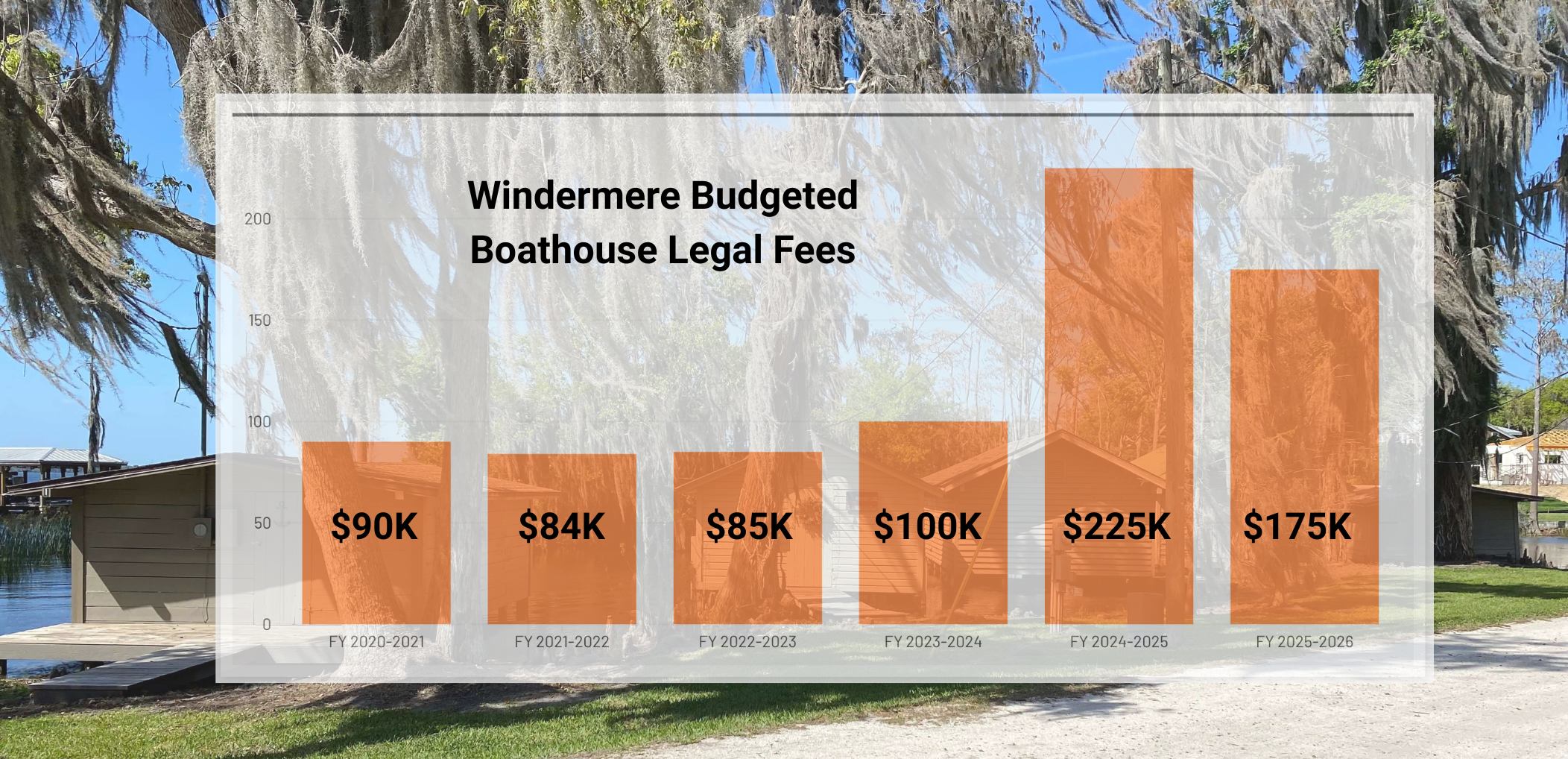
But a look at the town’s prior years’ budgets shows Windermere allotted a total of $585,000 for legal expenses between 2022 and 2026.
Here’s how it breaks down: Between 2020 and 2023, legal fees were consistently in the $84,000 to $90,000 per year range. In FY 23-24, legal fees increased to $100,000, then increased again to $225,000 in FY 24-25. Fees dipped slightly to $175,000 in FY 25-26.
But the town council overspent the $585,000 by a total of $163,928. And, according to GrayRobinson appellate counsel Rachel Crews, who spoke at the March 10 meeting, if the town opts to proceed with the appeal beyond the mediation phase, that could add another $100,000 to $200,000 in legal expenses.
Williams declined to say whether the new information about the town's higher legal expenses changed the calculus about pursuing the appeal. Last week, the town council rejected initial settlement offers from attorneys representing both sides, and the council is expected to convene in closed door (or shade) meetings on March 31 and April 6 at 6 p.m. to further discuss settlement strategy.
For those on the other side of the lawsuit, there is only incredulity.
“The lawsuit has become unmanageable and has to end,” Windermere realtor Judy Black told VoxPopuli by text on Saturday. Black's husband George Poelker owns a slip in the only boathouse with two berths. She brokered many of the home sales that included a boathouse. “I can’t see how any of this benefits the town residents,” she added.
Anne Fanelli, one of the named defendants, described the ongoing lawsuit as “frivolous” and “wasting taxpayers’ money.” She moved to Winter Garden after selling her Windermere home and boathouse to pay her legal bills.
“They don’t care how much they spend,” she said by text on Saturday, referring to the town council. “It’s not come out of their pockets personally. It’s the taxpayers’ money. It doesn’t affect the food they put on their families’ tables.”