"Local news worth reading" — The New York Times
SUBSCRIBE
The independent voice for West Orange County news
It was standing room only for the two-and-a-half hour Winter Garden City Commission meeting Thursday that resulted in a unanimous vote to re-zone 337+ acres in southwest Winter Garden from “no zoning” to “urban village planned urban development (PUD).”
The property, which juts out from Williams Road into a peninsula on Johns Lake, has been in developer Scott Boyd’s family for generations, according to a Feb. 6, 2023, letter Boyd sent Winter Garden City Manager Jon Williams. It will be built out over the next 10 years into the Johns Lake Urban Village, a community of 613 single-family homes, townhomes and estates; a 40-room hotel; a 200-person capacity events center; commercial district and public park. Early versions had included an Orange County elementary school, but that idea was rejected at a Jan. 14, 2026, community meeting over traffic concerns, according to Planning Director Kelly Carson. A public park replaced the school.
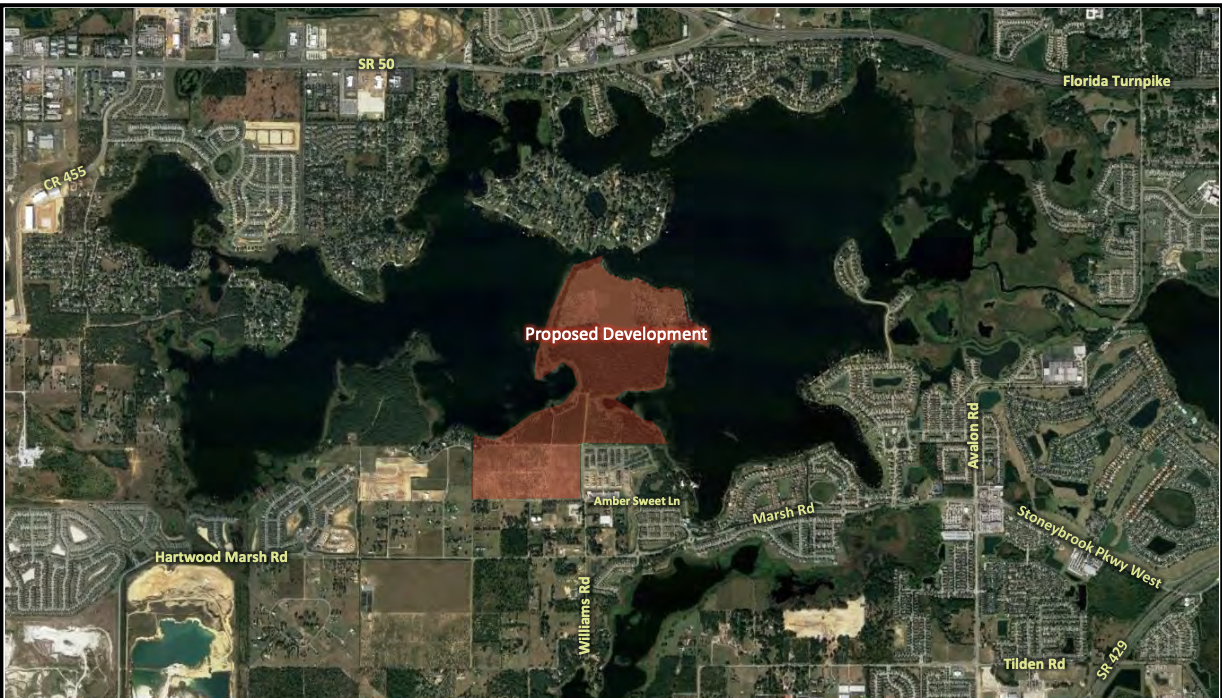
In a 40-minute presentation, Carson walked commissioners and attendees through the project and tried to assuage Winter Garden residents’ concerns about the planned community. She gave a similar presentation May 14 during the first reading of Ordinance 26-12.
She emphasized that the planning department had been “very thorough” with its review of Boyd’s application, saying that city staff had required six submissions and staff reviews. “That’s a lot of reviews for an application. That’s an unusual amount of reviews. We were very thorough with this review,” she said.
Carson also addressed social media posts and reporting in local news outlets, including VoxPopuli, that suggested Boyd and his team had drafted the ordinance commissioners were going to vote on. Emails, obtained through a public records request, that showed close collaboration between the city’s planning department and Boyd’s team had been posted on NextDoor. VoxPopuli reported that the redline draft of Ordinance 26-12 had 291 changes from Boyd’s team.
“We wrote it, the whole thing,” Carson said in her presentation. “We did send it over to the developer as a draft so they could review it. They suggested several changes as part of a redline set. And most of those changes were just clarifications and also to further memorialize and specify what those transportation responsibilities were of the developer. Nothing materially changed. It was mostly just new conditions to lock those down even tighter. And staff did not accept all of those changes. We removed the ones that were unacceptable to us and changed the … and kept the ones that were. So the developer did not write the ordinance. Staff did.”
Using Google’s AI Gemini program, VoxPopuli did a side-by-side comparison of the redline file marked up by Boyd’s team and the final version of the ordinance that commission members voted on. According to the analysis, 90 percent of the changes made by Boyd’s team were incorporated into the final document.
However, the city did add additional text to the ordinance that pertains to governing multi-phase construction caps; delaying certificates of occupancy until the New Independence Parkway Extension is completed; developer agreement conditions and noise buffering walls and landscaping. Overall, the analysis found the Boyd team's contributions amounted to 70 percent of the ordinance.
Neither Boyd, Shutts & Bowen attorney Paul Sladek nor consultant Heather Isaccs of Isaacs Strategy Solutions responded to VoxPopuli's request for comment.
The majority of those who crowded into Winter Garden City Hall’s commission chambers Thursday opposed the re-zoning ordinance — primarily because of traffic concerns. The Johns Lake Urban Village is expected to add 5,411 daily trips to the already overburdened Marsh Road. That’s on top of the 24,781 daily trips already being driven on the two-lane, once-rural road that was never intended to be a main thoroughfare.
Attendees urged commissioners to vote down the re-zoning ordinance or at least delay voting on it until additional roadways were in place to handle the traffic increase.
Sarah Matin, a civil engineer from Winter Garden and member of the board of directors for the American Society of Civil Engineers, pressed commissioners to consider the capacity of area roads to handle the additional traffic. She pointed out that the roundabout at Williams and Marsh roads that Boyd is required to construct as a traffic mitigator “is not going to improve capacity. A roundabout is to alleviate conflict points and to slow traffic flow … We’re at 25,000 trips, maybe at 30,000 trips. That roundabout’s not going to create an additional lane width, and we don’t have room on Marsh Road to add capacity at this juncture, nor on Avalon Road … We don’t want to limit development, but we want to understand, does the infrastructure, can it support these residents?”
Matin added that Tallahassee’s ballot proposal to eliminate property taxes ($150,000 in 2027, $250,000 in 2028) could also eliminate any funding for future road improvements.
Residents noted that Avalon Road also is “almost impassable” now because of traffic — something Matin noted had not been addressed in Boyd’s plans. “It’s like we’re ignoring the elephant in the room,” she said.
“You put that much more traffic on there, it’s going to make it incredibly difficult to live in this area,” said another Winter Garden resident who told commissioners she often has trouble exiting her townhome development off of Avalon and Stoneybrook West behind the Walgreens.
“You just sit there. Unless you get a very kind person that finally says, Let me let that person out,” she said.
Winter Garden resident Laurie Forrester noted that she liked the development plan, but the traffic studies were likely an underestimate because they did not account for the accessory dwelling units that can legally be built on every lot for aging parents or additional rental income.
“It might not be 613 dwellings. It could be 1,226 dwellings on that parcel because they are allowed, they are permitted to do that,” Forrester said.
A handful of people spoke in favor of the project, including Winter Garden’s Rick Steubing, president of the Johns Lake Association, who told the commission his organization backed the project because of its low housing density, which would benefit the lake.
“ Scott can make a lot more money if he sold this to a national developer out of California,” he said. “Those guys would come in and strip the property, bring in tract homes, go for maximum density, maybe more than four [units per acre] … especially around the lake, which means more homes on the lake than what Scott’s proposing, which isn't very many, which causes more runoff to the lake and more boat traffic.” He urged the commission to pass the ordinance.
Kelly Miller of Orlando, also said she liked the development and didn’t “see how it’s fair to pin the improvements and the traffic concerns to one particular development.” She wanted to see the project approved and then have Winter Garden and Orange and Lake counties make traffic “a priority across the different municipalities.”
City Attorney Kurt Ardaman later confirmed that developers are not responsible for resolving the traffic issues that predate their projects. It's up to the city, county and state governments to address those issues, he said.
Carson said the city had no plans to widen Marsh Road. They couldn’t even if they’d wanted to, she said, since it would mean cutting into residents’ backyards. She added that wider roads don’t reduce traffic; they create more.
“Once you build a road with a lot of lanes, it attracts a lot of people to that road because they see it as an easy way to get from Point A to Point B. Then over time the road fills up,” she said. “The folks out there have said they want to maintain the local character of the road. They want to maintain that 25 mph slow speed of the road, and they don't want to create a new Highway 50 in their backyard.”
A a couple of restrictions on Boyd are intended to slow the traffic increases on Marsh Road to allow infrastructure to catch up. Only 50 homes may be constructed at a time, Carson said. In addition, no certificates of occupancy will be distributed before New Independence Parkway is open or Jan. 1, 2028, whichever comes first. The parkway is expected to open next year. A connector from Wellness Way to State Road 429, is also expected to open in early 2027.
Marsh Road is at 83 percent volume to capacity, which Carson acknowledged is considered failing. But by 2030 with road improvements in place to divert traffic from Marsh Road, she said the volume to capacity is anticipated to drop to 65 percent.
At least until the next housing development is built.

