"Local news worth reading" — The New York Times
SUBSCRIBE
The independent voice for West Orange County news
A Republican-backed bill that would mandate citizenship verification to vote is fast-tracking through the Florida House.
Sponsored by State Reps. Jenna Persons-Mulicka and Dana Trabulsy, House Bill 991 (which had been replaced by a proposed committee substitute or PCS on Feb. 3) last week cleared the Government Operations Subcommittee on a straight party line vote with 11 Republican yays, five Democrat nays and two members absent.
Ocoee Rep. RaShon Young, a Democrat, attempted to replace the PCS/HB 991 by attaching the Harry T. and Harriett V. Moore Florida Voting Rights Act as an amendment, but it was ultimately voted down by the same margin.
PCS/HB 991, called the Election Integrity bill (but dubbed the “show your papers” bill by critics), is expected to be heard in the State Affairs Committee next week; if it passes, it will head to the House floor.
“This looks like a serious bill. It has all the markings of a bill that could pass,” Brad Ashwell, Florida state director of All Voting Is Local, told VoxPopuli by phone. He pointed to the bill’s sponsor, “who is well-regarded by leadership,” and the few committees slated to hear the bill.
“Usually that’s the tea leaf you look for,” he said. “ If they have like five committees, you know it’s maybe not going to pass.”

Presenting PCS/HB 991 to the Government Operations Subcommittee, Persons-Mulicka told members, “This PCS strengthens our citizens verification process.”
She explained that last year the Department of State found 198 people who were “registered to vote or did vote who were not or suspected to not be U.S. citizens.” Of those, she said, 170 were further investigated.
“In 2020, Floridians spoke loudly to say that we want to ensure that only U.S. citizens vote in our elections. And we enshrined that message into our state constitution. By a vote of 80 percent, Article VI, Section II was amended to state, Only a citizen of the United States who is at least 18 years of age and who is a permanent resident of the state, if registered as provided by law, shall be an elector of the county, where registered.”
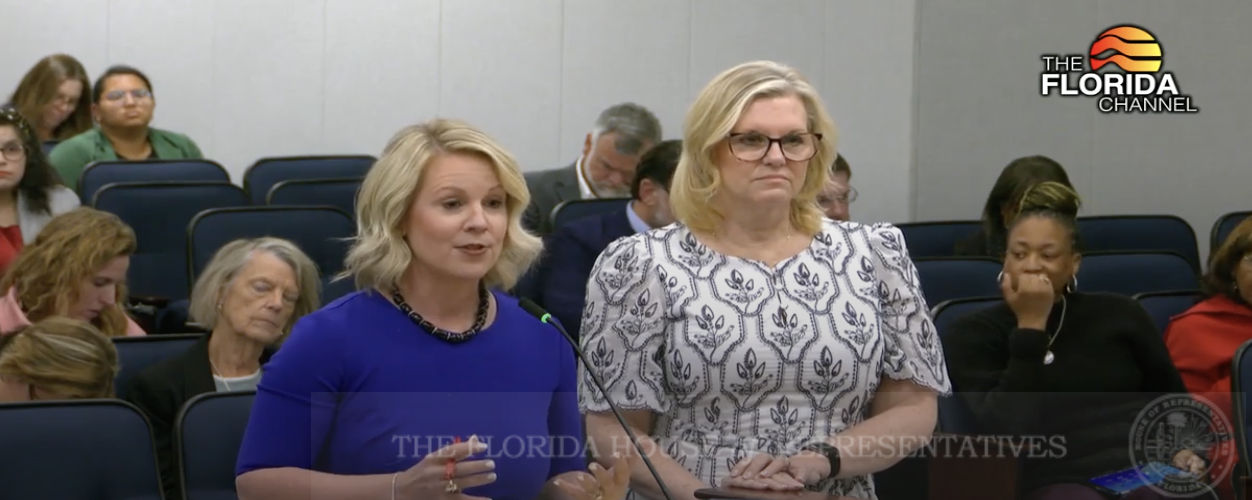
She noted that citizenship status will be included on driver’s licenses beginning July 1, 2027, and the bill requires the Department of Motor Vehicles to share citizenship information with the Department of State on a weekly basis.
She described the bill’s pared down list of acceptable IDs as a “common sense list.” Passport cards and U.S. uniformed services or Merchant Marine identification have been added, but student ID, retirement center ID, public assistance ID and debit and credit cards would no longer be accepted.
Mulicka was asked how many Florida voters could potentially be disenfranchised by this legislation; she sidestepped the question.
Committee member Rep. Phillip Wayne Griffitts, Jr., a Republican, commented before voting, “ This is very common sense. This is just rational thought. It's very good policy.”
But Griffitts was in the minority. Apart from the committee members who voted the PCS/HB 991 up, there were dozens of speakers during the hearing, who asked members to vote the bill down. Of the two people who supported the PCS during the discussion phase, one was the paid lobbyist from the Heritage Action for America.
Several opponents of the legislation argued it was an affordability issue for people who may not have a driver’s license or ready access to the documents required to get one.
Amy Keith, executive director of Common Cause Florida, a nonpartisan pro-democracy organization, described the PCS/HB 991 as a “poll tax” because of the costs associated with obtaining a Florida driver’s license.
“A Real ID costs between $32 and $197 for a U.S. citizen to receive in Florida,” Keith told the committee in the one minute she had to speak. “And that’s if you don’t need a birth certificate or proof of legal name change from another state. The bill's essentially saying that if you can't afford the specific documents, you don’t know how to vote. We do not know — and the sponsors don't know — how many hundreds or thousands or tens of thousands of U.S. citizen voters in Florida this bill will remove from the rolls.
“But we do know who it will hurt the most. It will hurt voters with disabilities, young people, seniors, people struggling to make ends meet, and voters who have lost everything in a hurricane. These are all U.S. citizens who have just as much of a right to vote as U.S. citizens who can afford all the paperwork required in this bill. Your right to vote should not depend on what you can afford.”
Miriam Tellechea, co-president of the League of Women Voters Tallahassee, cited a Brennan Center for Justice study that found 9 percent of Americans of voting age don’t have the documents that prove citizenship “readily available.” Extrapolating that to the eligible citizens of voting age in Florida, she calculated 1.6 million voters could be disenfranchised. Legislation like this disproportionately affects the Black community — the Brennan Center study found that 11 percent of Black voters didn’t have the necessary documents compared with 8 percent of white voters.
“Everyday Floridians can’t afford additional expenses right now,” Tellechea told the committee. “The constitutional right to vote is free to every eligible American voter, and requiring Floridians to decide between putting food on their table or getting an expensive paper to prove their citizenship in order to vote is unfair and unnecessary.”
Ashwell told VoxPopuli that PCS/HB991 was a solution to a problem that didn’t exist.
“ It's creating a lot of hoops people have to jump through and for what?” he said, adding that the state constitution already dictates severe penalties if a noncitizen votes. “They’re suggesting that there are people who might be doing it … but they’ll hold up numbers that are pretty lackluster and don’t justify this sort of heavy-handed maneuver that could be disruptive.”
Florida is not the first state to try to pass a proof of citizenship-to-vote law, according to Keisha Mulford, deputy director of communications for ACLU Florida.
“A similar law in Kansas led to over 31,000 eligible citizens being blocked from voting before the law was ruled unconstitutional and struck down by the courts,” she told VoxPopuli by text.
Enacted in 2013, the Kansas law mandated that residents show proof of citizenship, like a birth certificate, passport, naturalization papers or driver’s license, to vote. In 2018, a federal judge overturned the law, saying it violated the National Voter Registration Act and the 14th Amendment. Between 1999 and 2018, a total of 11 Kansans had voted illegally.

In a long-shot maneuver, Young offered the Harry T. and Harriet V. Moore Florida Voting Rights Act (House Bill 1419) as the sole amendment and replacement for PCS/HB 991.
This is the third year Democrats have attempted to get this bill on an agenda and heard in committee. It was originally drafted by the late Sen. Geraldine F. Thompson and Sen. LaVon Bracy Davis when she was still in the House. Rallies were held outside the Capitol in Tallahassee in 2024 and 2025 to demand the bill, supported by the Democratic Caucuses in both chambers, be heard and passed.
In introducing the FVRA, Young mentioned a few of its features, including same-day voter registration, pre-paid postage for mail-in ballots, standing mail ballot requests and establishing Election Day as a paid holiday.
Young said his amendment “recognizes that barriers to the ballot box didn't stop at literacy tests, they just simply evolved. And by modernizing registration and removing cost barriers and protecting against suppression, we're continuing the work of ensuring democracy is accessible to all, not just to a few.”
Republican committee members questioned whether early voting didn’t already provide ample access for voters; whether an Election Day holiday was worthwhile since it may only benefit salaried workers; and whether Young was trying to create an option for people who wanted to vote but not by mail.
After all of the speakers were finished, Rep. Fabián Basabe, a Republican of Miami-Dade, perhaps best summed up the mood of the committee.
“ I'm just recognizing that we're here many months in advance of our next election, and people are already making excuses," he said. "So at some point the distraction narrative is, you know, gonna get a bit tired. Citizens vote. Period. And protecting that right requires both access, which in this state we do really well. Resources are heavily invested in to make that access so available. And the other is personal accountability, which even the failed amendment proves that some people just refuse to support. At some point, the excuses have to stop.”
Young got the final word before the committee, which had already voted down his amendment, voted to pass PCS/HB 991. He said he was "frustrated."
“I am tired of watching us call barriers ‘integrity,’” Young said. “I am tired of us dressing disenfranchisement up in the language of security. Because let's call this bill what it is. It does not protect democracy. It restricts it. … It's already illegal for non-citizens to vote. It is prosecuted, It is punishable. So this bill is not solving an existing crisis. It's creating a new barrier for people to be able to access the ballot box, and the people caught in that barrier will overwhelmingly be eligible Floridians, people who are already voting, people who are already on the roll.
“And so I'm frustrated. … I’m frustrated that instead of expanding access, we are restricting it. I'm frustrated that instead of encouraging participation, we are policing it. That instead of building trust in our democracy, we are eroding it time and time again. Because at its core, this bill does indeed send us a message, a message about who we trust, about who we don't, and who we want to participate.
“Democracy works best when participation is high and barriers are low. And I believe the right to vote should be protected … I believe history will judge how we handle moments like this.”