"Local news worth reading" — The New York Times
SUBSCRIBE
The independent voice for West Orange County news
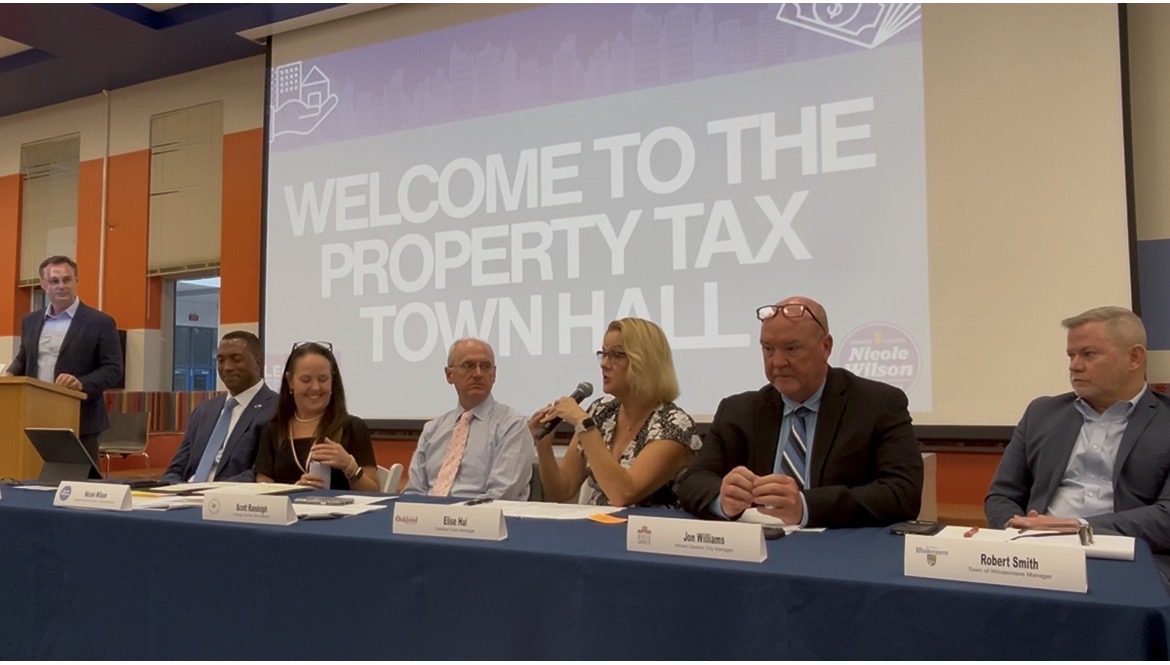
About 120 people packed the cafeteria at West Orange High School in Winter Garden last week for a two-hour town hall on property taxes and Amendment 3.
The event was organized and hosted by District 1 Orange County Commissioner Nicole Wilson and included State Rep. Leonard Spencer of House District 45; Orange County Tax Collector Scott Randolph; and three town/city managers: Elise Hui of Oakland, Jon Williams of Winter Garden and Robert Smith of Windermere.
The town hall was moderated by investigative journalist Jason Garcia, producer of the Seeking Rents newsletter and podcast.
As the forum approached the 8 o’clock hour, Garcia marveled, “This is like amazing that people stayed for two hours, right?” He added it was rare to see a dry topic like property taxes generate such interest.
But with the midterm elections just two months away, social media platforms, like Nextdoor, are clogged with posts urging people to VOTE YES! or VOTE NO! on Amendment 3, which would expand the homestead exemptions for a primary residence from $50,000 to $150,000 in 2027 and to $250,000 in 2028. The amendment would also lower the assessment cap on non-homestead property from 10 percent to 5 percent. The ballot measure needs 60 percent approval to pass.
An August poll from the James Madison Institute found robust support for the property tax cut — but support drops as voters learn more about the amendment. In the survey, 76 percent of likely voters poll supported Amendment 3. But when asked about local governments having less funding for services, only 55 percent of likely voters still supported the measure. And 36 percent “expressed concern about reducing local government services or shifting costs elsewhere.”
Shifting costs and service reductions turned out to be major themes of the evening’s discussion. Here are six key takeaways from the Property Tax Town Hall.
Garcia described Amendment 3 as “the most significant thing on the ballot” in November but noted that the time taken to create, consider and pass the ballot proposal during a special legislative session in June lasted all of “about 27 hours.”
Spencer elaborated on the process, explaining that legislators began talking about property tax reform in 2025 and had requested a $1 million study on the impacts of reducing property taxes. He said the study was intended to:
“examine how the property tax system works… How local governments use the revenue from property taxes. It was also supposed to look at what would happen if we significantly reduced or eliminated ad valorem taxes and homestead properties. And it was supposed to identify ways that we were going to address the potential financial consequences …”
The study never happened because, Spencer said, Gov. Ron DeSantis vetoed its funding. Lawmakers didn’t pass property tax reform in the regular session because the House and Senate couldn’t agree, so a special session was called. Spencer said during that three-day session, there was a single House committee hearing, little time to review the proposal and no financial analysis.
“The legislature had to do ad hoc analysis on the back of paper napkins to try to understand what it could be before we actually, took a vote,” he said.
Now that Amendment 3 is on the ballot, Spencer said, “we’re having these conversations to really understand the full impact of what was actually passed.”
All Floridian homeowners are immediately eligible for the $25,000 homestead exemption from all property taxes on their primary residence and another $25,000 for non-school taxes.
With Amendment 3, however, people moving to Florida after Dec. 31, 2026, would only be eligible for the higher exemptions after they’d established five years of residency. Wilson said it was unclear how residency would be defined, and both she and Spencer said this waiting period was expected to generate court challenges over the amendment’s constitutionality.
Wilson was particularly concerned about how the waiting period could affect active-duty military.
“If you’re in the military and you’re moved for a year and then you move back, do you start all over again?” Wilson asked rhetorically. “There was never any contemplation of what would happen to our military members. This isn’t about their homestead, which we know they can establish, serve, come back to and it has its own regulatory scheme.”
The city/town managers on the panel were unified in their message that the niceties that drew residents to Winter Garden, Oakland and Windermere would likely be the first cut in the name of maintaining funding for public safety services.
“We typically look at needs versus wants,” said Smith who talked about delaying capital improvement projects and reducing the budgets for parks and new sidewalks to ensure that Windermere police have “the best equipment, the best training and whatever things they need” to protect the town.
“The needs are keeping the lights on, making sure that our police, fire, public works, our roads, they're in safe condition and able to operate,” he continued. “The wants are what I think brought you all to West Orange County. Making sure the landscaping is good, making sure you have sidewalks to walk with your kids, multimodal paths … But there's things that we're gonna have to eliminate and/or put a pause on for quite some time.”
Although Winter Garden is awaiting the outcome of the midterm elections before making any decisions, Williams said Winter Garden would need to cut all other departments’ operating budgets by 29 percent to maintain the police and fire-rescue departments at current levels.
“At that point, you're starting to cross thresholds where you start making decisions on whether or not you're just totally eliminating departments altogether and not providing those services,” he said.
Like the city’s downtown special events — which cost the city about $1 million annually and are free to all comers — and the recreation programs, which cost the city another $1.9 million and include youth sports, adult fitness, after-school, gap camps and aquatic programs.
A less dramatic across-the-board cut of 15 percent, Williams said, would include cuts to police and fire-rescue departments too. “There is going to be ultimately an impact into your quality of life services and those life safety issues,” he said.
Oakland’s Hui said they’re taking a broader view. “Everything is on the table.”
Raising the homestead exemption is without question a money-saver, Randolph said. That’s incentive to vote for Amendment 3 for anyone, but especially for people who bought their homes in the last five years, who, Randolph said, are “getting killed by property taxes” because the property tax structure disfavors first-time Florida home buyers.
“There’s no doubt you are taking the full brunt of that market value increase,” he said.
But the amendment’s savings come with a big caveat, he cautioned, because local governments can use non ad valorem assessments, which have no cap and are not based on a home’s value, to help close budget funding gaps.
“Non ad valorem assessments can really vary wildly. You can have non ad valorem assessments that apply to one block, one neighborhood, the whole community,” he said. “Some long-term homeowners that think they’re getting a property tax cut could suddenly see their overall property tax bill, ironically, increase.”
Hui said that Oakland couldn’t absorb Amendment 3’s impact through budget cuts alone and was “definitely looking at non ad valorem assessments for fire and stormwater.”
“ We don't have park and rec programs. We don't have a library. We don’t have a local pool. There aren’t things that we can charge fees for for entrance or admission,” she said. “These are not painless choices.”
Garcia explained that the Florida Constitution reserves property tax assessments as a source of local revenue for local governments while all other revenue sources are the purview of the state Legislature and governor. Passage of Amendment 3, said the officials at the town hall, would erode home rule and make local governments dependent on Tallahassee for funding.
“That was the point,” Wilson said. She added that Tallahassee has been steadily chipping away at home rule with the passage of Senate Bill 180 and the nullification of Orange County’s Vision 2050.
Local government is growth management and “one of the most important ways for us to cut municipal and county costs,” she said, adding there’s a key connection between uncontrolled sprawl and cost of living.
“Local government is backyard. It is your growth management. It's where we get to have a conversation about zoning and future land use. And when that's gone — which effectively under SB 180 that was completely undermined — then we can't keep any cap on those costs. Those costs now — the cost of continued sprawling roads and water and garbage and landfill space — will continue to go up until we have the ability to really navigate growth management.”
Town hall participants said they were in favor of property tax reform but not this amendment. They favor tax reform that’s fair, that doesn’t leave out key constituencies or make certain Floridians wait to claim the benefits, whose mechanisms and impacts are clearly understood and that maintain decision-making in the hands of local governments. To quote former President Ronald Reagan, as Spencer did, “a government works best that’s closest to the people it represents.”
“ If property taxes are supposed to reflect the services you're getting, we've got to find a better way to keep it fair for everybody,” Randolph said.
Winter Garden’s Williams said, “I 100 percent support” asking voters if they want to continue paying property taxes. But he added, “I have a fundamental problem with allowing folks in Miami, Tallahassee, Jacksonville, and Tampa making decisions for you. You made these investments in these communities. You decided to buy here. You decided to open a business here for a quality of life. Therefore, I think you should be the sole determining factor in whether or not you continue to pay taxes.”


